Adhesive-Backed Parts Explained
Adhesive Backed Silicone Gaskets: Selection and Testing
Define the adhesive function, evaluate both bonding surfaces and validate the converted gasket in its intended assembly.
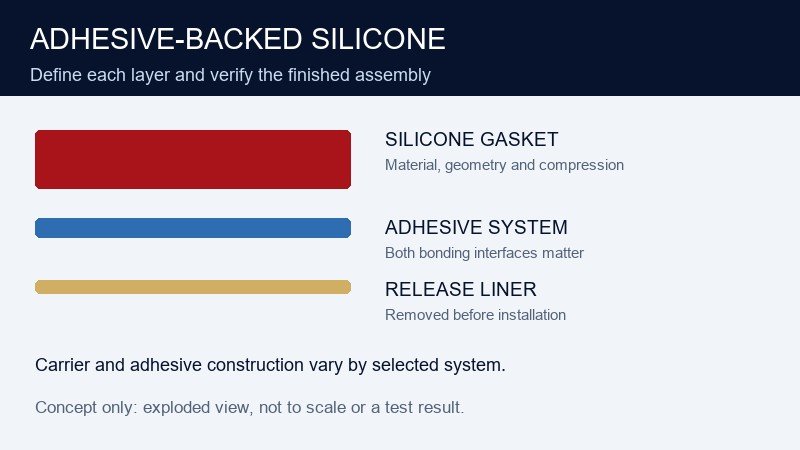
A silicone gasket that stays in place during assembly can still fail to seal after the cover closes. Adhesive backed silicone gaskets combine a compressible component with a bonding system, and each part of that construction needs its own requirements. For enclosure designers, purchasing teams and assembly engineers, the useful starting point is to define what the adhesive must do before choosing a tape name or ordering a roll.
An adhesive may hold a frame on a vertical panel while an operator installs fasteners, retain a pad during shipping, or form part of a specifically validated bonded joint. Those duties lead to different questions about substrates, handling, service conditions and acceptance testing. A strong first impression when peeling off a liner does not answer all of them.
This explainer separates the silicone, adhesive and liner decisions, then shows how to turn them into a drawing and approval plan. The examples are proposed engineering scenarios, not reported customer results. The objective is a specification that can be checked consistently when samples become repeat orders.
1. What are adhesive backed silicone gaskets?
Adhesive backed silicone gaskets are silicone sealing components supplied with an adhesive layer and a removable release liner. The adhesive can help position the gasket during assembly. Reliable sealing still depends on the joint geometry, silicone properties, compression and exposure conditions unless a different sealing mechanism has been specifically validated.
A simple construction contains silicone, adhesive and a protective liner. Other constructions add a carrier with different adhesive formulations on opposite faces. The liner is removed before installation; the permanent layers remain in the assembly and must be included when their thickness affects the fit.
The word silicone identifies the gasket material, but it does not automatically identify the adhesive chemistry. A purchase description such as self-adhesive silicone therefore leaves several decisions open. Ask which adhesive faces the silicone, which face bonds to the housing, and whether a carrier or treatment is involved.
LSAN's die-cut silicone parts capabilities include adhesive-backed components reviewed for positioning and kiss-cut parts retained on a liner. That makes a drawing-led review useful for flat frames, washers and pads where outline, thickness and assembly presentation must be considered together. Availability of a particular adhesive construction still needs project confirmation.
Rogers Corporation's BISCO Silicones Adhesive Application bulletin describes pressure-sensitive adhesive as a manufacturing aid for placing parts during processing. That is a useful distinction to carry into an RFQ: a positioning requirement should be stated as such, with the later sealing requirement documented separately.
2. How does pressure sensitive adhesive fit into the joint?
A pressure sensitive adhesive, often abbreviated PSA, bonds through contact under applied pressure without a separate mixing step at installation. The selected product's instructions still control application conditions, pressure, dwell and any surface preparation. Treat those instructions as part of the manufacturing process rather than assuming all peel-and-stick products behave alike.
Three functions are worth separating before comparing candidates:
| Intended function | What the buyer needs to define | What still requires evidence |
|---|---|---|
| Assembly positioning | Orientation, handling time and acceptable movement before closure | Whether the gasket remains aligned through the real assembly sequence |
| Retention during service | Loads, temperature, exposure and maintenance handling | Whether the complete bond survives those conditions |
| Contribution to sealing | Actual leakage path and how the bonded interface closes it | Performance of the assembled joint, including edges and discontinuities |
For a mechanically compressed frame gasket, start by reviewing the cover, flange and fastening arrangement. The adhesive does not establish a suitable compression window simply because it holds the frame in place. LSAN's custom silicone gaskets and seals page describes the same joint-level approach to geometry, compression, temperature and media.
Consider a proposed vertical electrical enclosure assembly. A production engineer might need the gasket to stay aligned while the cover is fitted, then rely on the closed joint to maintain the specified seal. The relevant handling trial would include liner removal, placement, the delay before closure and the actual fastening sequence; a tape coupon alone would leave those steps unexamined.
Now consider a removable service panel. The engineer must decide which surface should retain the gasket when the panel opens, whether the gasket is reusable, and how a replacement is installed. Those decisions can change the adhesive requirement even when the silicone material and overall dimensions stay the same.
3. Selecting a silicone gasket adhesive starts with both surfaces
There are at least two interfaces to investigate: adhesive to silicone and adhesive to the mating component. A construction that bonds well to one surface may be unsuitable for the other. Identify both surfaces precisely before comparing product data.
3M's Surface Science Basics explains that surface energy, cleanliness and roughness affect intimate adhesive contact. In practical terms, a material name alone is incomplete information. Record the surface actually presented to the adhesive, including a coating, finish, treatment or residue that may differ from the bulk material underneath.
For example, painted metal should be described by its coating and condition, not only by the underlying metal alloy. 3M's Substrates and Adhesion specifically identifies the coating as the bonding surface on powder-coated parts. A sample of bare metal therefore should not be treated as a substitute for the finished panel without a reasoned validation plan.
Chemistry is a starting category
Rogers' How to Choose the Right PSA for Your Enclosure Components discusses rubber, acrylic and silicone adhesive families and differential constructions. These categories help organize a supplier conversation, but they are not a ranking that identifies the best product for every silicone gasket. The proposed grade, construction and actual substrates remain decisive.
A differential construction may use different adhesive faces to address dissimilar surfaces. If one is proposed, make the orientation unambiguous in the specification and sample labeling. A buyer should also ask which supporting test data applies to each interface and which data applies to the converted gasket as supplied.
Define the sample surface
- Identify the silicone grade, surface finish and any preparation used before lamination.
- Provide the mating part or a representative finished coupon, including its coating and texture.
- Describe cleaning, handling and storage before adhesive application.
- Identify whether the bond is permanent, serviceable or intended only to assist assembly.
- Agree how substitutions to a coating, adhesive or preparation process will be reviewed.
These details prevent a common purchasing ambiguity: two quotations can use the same broad adhesive family while referring to different constructions and qualification assumptions. Ask suppliers to state exclusions and unresolved conditions before comparing price.
4. What changes with liners and kiss cut silicone gaskets?
The release liner protects the adhesive before use and influences how the operator handles the part. Kiss cut silicone gaskets are cut through the intended part layers while leaving a supporting liner sufficiently intact to carry the pieces. The production specification should describe the finished presentation instead of relying on the process name alone.
For a narrow frame, define how the operator starts removal without stretching the part. A lift tab, a split liner or a sheet layout might be considered, but the chosen solution needs a handling trial. The useful outcome is controlled placement within the agreed positional tolerance, not merely a clean-looking roll at incoming inspection.
| Presentation choice | Question to resolve before approval |
|---|---|
| Individual pieces | How are parts separated and protected during transport and handling? |
| Parts on sheets | Can the operator remove one piece without disturbing its neighbors? |
| Parts on rolls | Is the unwind direction compatible with the fixture or dispenser? |
| Split or extended liner | Can the operator position the part without touching the bond face? |
| Removed internal waste | Are holes and windows clear, and can loose waste enter the assembly? |
Draw the adhesive coverage explicitly. Some projects may require full coverage, while others need defined exclusions around openings or specific edges. Do not leave a functional adhesive-free area to be inferred from a silicone outline drawing.
Also distinguish silicone thickness from total supplied thickness. A measurement that includes the liner is different from the permanent stack installed in the joint. The drawing should identify the relevant thickness definition, measurement conditions and tolerance rather than combining values that were obtained differently.
For an assembly team using a placement fixture, review a representative converted sample in that fixture. Record whether the liner releases cleanly, whether the part can be placed without distortion and whether the required orientation is obvious. This is an editorial recommendation for approval planning; it does not imply a particular LSAN process tolerance or production result.
5. Installation and exposure conditions belong in the specification
Application conditions and service conditions describe different stages. A component may be installed in one environment and then operate in another. Capture both, including any storage or transport stage that falls between conversion and final assembly.
The adhesive supplier's documented instructions should control the proposed preparation method. Cleaning agents, primers or surface treatments must be compatible with the actual silicone, coating and adhesive construction. Avoid borrowing a preparation recipe from an unrelated tape product simply because both products are pressure sensitive.
3M's Changing Surface Properties for Better Adhesion discusses modifying a surface to improve bonding. For a production specification, the implication is that a treatment is an additional controlled process variable. If a sample was treated before testing, that condition needs to remain visible when the result is used to support production approval.
Use an exposure description that the supplier and test team can turn into a plan:
- Application: part temperature, environment, preparation, placement pressure and allowed handling delay.
- Operation: temperature history, duration, orientation and mechanical movement.
- Contact: water, cleaners, oils or other media, including how contact occurs and how often.
- Maintenance: opening cycles, cleaning, replacement and residue expectations.
- Storage: packaging, shelf-life controls and the supplier's stated storage conditions.
Do not transfer the silicone's temperature claim directly to the finished adhesive-backed construction. The silicone, adhesive, carrier and any remaining bonded interfaces must all be considered. Ask for evidence that is relevant to the proposed assembly and exposure, rather than selecting a product from a single headline value.
A second proposed scenario is a washable industrial panel. Its engineer should identify the cleaning chemical, concentration and contact pattern, then include the relevant exposure in evaluation. Saying washable without those details leaves both the adhesive requirement and the sealing test open to interpretation.
A third scenario is a sensor pad attached inside a housing. If its function is retention or cushioning rather than sealing, the acceptance criteria should describe that function directly. Calling every silicone pad a gasket can inadvertently introduce an assumed leak requirement or obscure the actual retention duty.
6. What should be tested before production approval?
A gasket approval plan should evaluate adhesive bonding, assembly handling and sealing as separate questions. Tape data can help screen a construction, but the converted part and finished joint need evidence under agreed conditions. Record the substrates, preparation, conditioning, exposure and acceptance criteria so the result can support repeat supply.
3M's Adhesive Bond Strength distinguishes stress modes such as peel, shear and tension. The practical point is to select tests that address the duty of the actual joint. A high result under one loading arrangement should not be treated as a universal statement about the assembled component.
ASTM D3330/D3330M addresses peel adhesion of pressure-sensitive tapes, while ASTM D3654/D3654M addresses shear adhesion. These names identify different test subjects, not interchangeable approvals. The responsible test team should agree the applicable edition, method, specimen construction and any deviations before using results for purchasing decisions.
The published D3330 scope also notes that backing characteristics can affect the response. This matters when comparing a tape supplier's data with a flexible silicone-backed converted specimen. Report the specimen construction and failure observations rather than interpreting every measured difference as an adhesive-chemistry difference.
A practical approval sequence
- Define the function. Separate positioning, retention and sealing requirements, with an owner for each acceptance decision.
- Screen the construction. Review the proposed silicone, adhesive, carrier and liner, including the exact surfaces and exposure assumptions.
- Evaluate representative samples. Use the agreed preparation and application process, and record the conditions before testing.
- Run the assembly trial. Check removal from the liner, orientation, placement, delays and cover closure using the intended workflow.
- Evaluate service conditions. Apply the agreed environmental and functional tests to representative parts or assemblies, as appropriate.
- Freeze the approved specification. Record the drawing revision, material identities, presentation and controls needed for repeat orders.
Acceptance criteria should be agreed before the trial. Depending on the function, they may address displacement, edge lift, adhesive transfer, liner removal, part damage or leakage under a defined setup. Do not select a pass threshold after seeing the result simply to qualify the available sample.
Retain useful failure observations. Separation at the housing, separation at the silicone, failure within an adhesive layer and tearing of the silicone describe different events. Photographs and a clear description can help the parties investigate without overstating what a single test proves.
7. Turning the decision into an RFQ and repeat-order control
An RFQ should let a supplier identify the proposed construction and the information still missing. Start with a revision-controlled drawing and a concise statement of function. Add a representative mating surface when a written coating description would not adequately reproduce the bond condition.
| RFQ item | Information to include |
|---|---|
| Geometry | Outline, openings, critical dimensions, tolerances and adhesive coverage |
| Silicone | Grade direction, thickness definition, hardness or cellular material requirements |
| Adhesive system | Approved product if fixed, or performance requirements if selection remains open |
| Mating surface | Material, coating, texture, preparation and representative samples |
| Presentation | Sheet or roll format, liner features, orientation and packaging |
| Validation | Function, exposure, agreed tests, acceptance criteria and reporting needs |
| Supply scope | Sample quantity, order quantity, forecast and required documentation |
A price comparison is more meaningful when each quotation states the same scope. Tooling, converting, adhesive construction, waste removal, liner features and inspection can all be separate discussion points. There is no defensible universal price premium for adhesive backing without defining those details and the order conditions.
For repeat orders, keep an approved sample and the supporting specification together. Identify which changes require review, such as a different adhesive product, a new coating on the mating part or altered liner presentation. The aim is to preserve the basis of approval while allowing changes to be assessed deliberately.
If the project has a documentation requirement, state it at enquiry. Evidence for the silicone alone does not automatically describe every other component in an adhesive-backed assembly. Ask the supplier to identify exactly which material or finished construction a document covers, and resolve any gap against the intended use.
8. Buyer questions about adhesive-backed gaskets
Can adhesive backing replace fasteners or gasket compression?
Only a design validated for that duty should rely on adhesive for structural retention or sealing. For a conventional compressed gasket, the backing commonly helps position the component while the joint provides the required compression. Review the intended load path and seal mechanism before removing any mechanical feature.
Is silicone adhesive always the right choice for silicone rubber?
The family name alone is insufficient. Both the silicone-side bond and the mating-surface bond need evaluation, together with exposure and processing conditions. A supplier may propose a treated or differential construction, but that proposal still needs evidence relevant to the finished application.
Can a removed gasket be stuck back down?
Do not assume that a previously installed adhesive-backed gasket is reusable. Removal can change its shape, contaminate the adhesive or damage a bonding surface. Define a replacement procedure unless reuse has been specifically evaluated and included in the maintenance instructions.
Are kiss-cut gaskets more economical than individual pieces?
The answer depends on quantities, geometry, material utilization, liner construction and the assembly workflow. Compare the quoted supply cost alongside handling, waste removal and inspection requirements. A representative line trial is more useful than assuming that one presentation always reduces total cost.
What sample should accompany an adhesive-backed gasket enquiry?
Provide the finished mating surface when possible, together with a controlled gasket drawing and the intended silicone requirements. Include the actual coating or finish and describe installation, operating conditions and cleaning. State whether the adhesive is intended for positioning, long-term retention or a validated sealing function.
9. Request a review of the gasket and its mating surface
Prepare one review package that connects the gasket drawing to the assembly operation. Include the intended silicone, adhesive duty, mating-surface details, exposure conditions and the preferred liner presentation. If a selection is still open, identify the requirement instead of filling the gap with an unverified product assumption.
LSAN can review the flat-part geometry and manufacturing direction alongside the information needed for a responsible quotation. The useful next step is to agree what will be supplied as a sample and what that sample must demonstrate before production approval. A clear review also makes unresolved assumptions visible to purchasing and assembly teams.
Request a silicone part drawing review with your drawing and application details so the construction, handling and validation scope can be discussed together.