Silicone Processing Explained
Silicone Post Curing: Process, Purpose and Validation
Connect material selection, post-treatment requirements and final inspection to a documented approval plan.
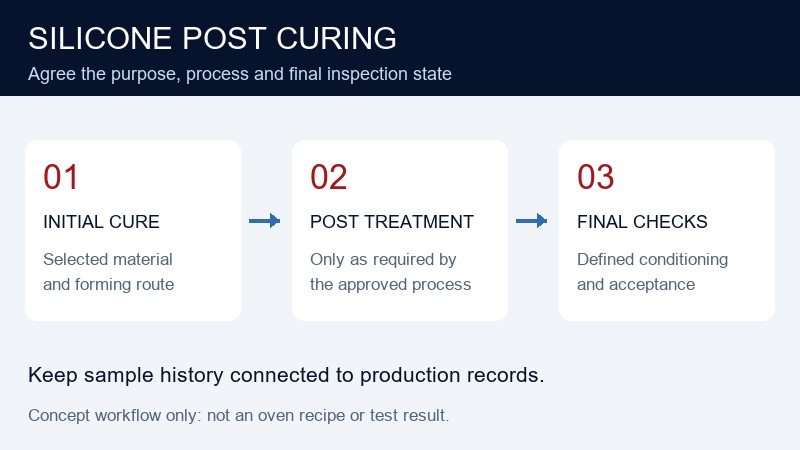
A silicone part can leave the mold with the correct shape while still needing another controlled processing step before approval. Silicone post curing is a treatment applied after the initial cure, with requirements that depend on the formulation, component and intended use. Buyers should define its purpose and the evidence needed from the finished part before treating an oven cycle as a complete specification.
For a purchasing engineer, the immediate question is whether the quoted material data describes the same condition as the parts being supplied. For a designer, it is whether dimensions and functional properties are verified after all agreed processing. For a quality team, it is whether production records connect that approved condition to repeat orders.
This article explains those distinctions and provides practical questions for a supplier review. It does not prescribe a universal temperature or duration, and the scenarios are illustrative approval plans rather than customer test results. Start with the material supplier's current instructions, then qualify the actual component and manufacturing route against the project's requirements.
1. What is silicone post curing?
Silicone post curing is a controlled treatment after the initial cure, commonly involving a defined heat exposure. Depending on the formulation and application, it may reduce volatile components or develop specified properties. Its necessity and conditions must be established for the selected material and finished part rather than assumed from the word silicone.
Initial curing turns the uncured formulation into an elastomer through crosslinking. Post curing is a later operation and should have a separately stated purpose. A note that says cured silicone does not, by itself, tell the buyer whether that later operation was performed or what condition was used for inspection.
WACKER's Solid and Liquid Silicone Rubber: Material and Processing Guidelines identifies property development and removal of volatile components among the reasons for post curing. It also distinguishes peroxide reaction by-products from low-molecular components and describes part-specific process checks. These are reasons to investigate a treatment, not evidence that every silicone article requires the same cycle.
Why the distinction matters in purchasing
Imagine two suppliers quoting the same nominal hardness. One provides data obtained after a specified post treatment; the other proposes parts measured immediately after molding. Until the conditions are aligned, the documents do not establish that the delivered parts are equivalent.
Ask each supplier to identify the material, initial cure, any post treatment and the condition of the tested specimen. If some information is proprietary, agree on a controlled process reference and the evidence available to the customer. The purchasing objective is a traceable approval basis, not unnecessary disclosure of a supplier's confidential formulation.
LSAN's silicone molded parts capabilities connect drawing review, material selection, sampling and inspection. That provides a practical starting point for discussing when a molded component will be inspected and which processing assumptions need confirmation. Specific treatment conditions and documentation remain subject to the project review.
2. How does the silicone curing process affect the decision?
The silicone curing process describes more than the machine used to make a shape. A material family, curing chemistry and manufacturing route are related but different pieces of information. Include all three when they are relevant to the drawing or qualification plan.
Elkem's Different Processing Methods for Silicone Rubber notes that high-consistency rubber can use peroxide or platinum curing. Therefore, a description such as compression-molded HCR does not completely identify the cure system. Conversely, a reference to platinum curing does not define a finished part's complete processing history.
| Term on a quotation | What it helps identify | What still needs clarification |
|---|---|---|
| Compression molded | A forming route | Grade, cure system and final inspection condition |
| Liquid silicone rubber | A material and processing category | Exact grade, process and application evidence |
| Platinum cured | A curing chemistry | Whether post treatment is required for the intended use |
| Post cured | A later processing step occurred | Controlled process reference and verified outcome |
| Non-post-cure grade | A formulation offered for a defined processing approach | Applicable conditions and finished-part acceptance |
Elkem's What Are RTV-2 Silicones? distinguishes addition and condensation systems and their reaction behavior. This is another reason to keep a room-temperature-curing mold material, an injection-molded elastomer and a sealant out of a single generic oven recipe. Material-specific instructions take precedence over an informal rule borrowed from another silicone product.
For a project review, request the current technical data sheet and ask which entries are typical values rather than agreed purchasing limits. Identify any pigment or other approved modification that belongs to the supplied formulation. Record the revision of the information used for approval so a later change can be evaluated against the same starting point.
Separate the decision from the label
The useful question is not whether one cure-system name sounds more advanced. It is whether the selected construction and process meet the defined requirement with appropriate evidence. A supplier should be able to explain the proposed route and identify what remains unverified before the customer approves production.
3. Does silicone volatile content tell the whole story?
Silicone volatile content can be one reason for reviewing a post treatment, but the requirement needs a defined test basis. A description such as low volatile is incomplete unless it identifies what is measured, how the sample is prepared and which criterion applies. Ask the test owner to specify those details before comparing reports.
Momentive's LSR Post-Curing Recommendations explains that the appropriate treatment can depend on the OEM specification, actual geometry, preceding molding and downstream storage. It also states that end-article producers must confirm applicable compliance through relevant testing. A raw-material example therefore cannot automatically stand in for a differently shaped finished component.
Keep several questions distinct in the approval plan:
- Is the objective a defined material property, a volatile-content result or both?
- Does the report describe a molded test piece or the actual component?
- Were the samples tested as molded, after post treatment or after another conditioning step?
- Are the method, units and acceptance criterion stated clearly?
- Does the report cover the supplied formulation and the intended processing condition?
An odor observation can be useful as an incoming-inspection note, but it should not replace a required analytical result. Equally, the absence of a visible surface deposit does not document completion of an agreed cycle. Record observations for investigation while keeping the formal acceptance method explicit.
Do not turn a process statement into an approval claim
Post treatment is a manufacturing operation, not a certificate. If a project needs food-contact, medical-use or another application-specific assessment, the relevant responsible team must define the evidence for that intended use. Avoid accepting a statement about oven exposure as proof of all finished-product requirements.
This distinction also improves communication with a supplier. Instead of asking for vaguely compliant silicone, provide the intended contact, environment and documentation scope. The supplier can then identify which records cover the material, which cover the processed part and which evaluation remains the customer's responsibility.
4. Why there is no universal post-cure temperature and time
A supplier's recommended process belongs to a specified material and set of conditions. It should not be transferred automatically to a different thickness, formulation or composite assembly. The project needs a controlled process window supported by representative evaluation, rather than a single number copied into every drawing.
WACKER's processing guidance describes the importance of air supply, part arrangement and checking conditions for the actual article. Its Room Temperature Vulcanizing Silicones guide also discusses post-treatment choices for particular RTV systems. Neither document is a substitute for obtaining the correct instructions for the selected product and production equipment.
For buyers, the practical response is to ask what process factors were included in the approval. The following questions are proposed review prompts, not an operating procedure:
| Process question | Why it belongs in the review |
|---|---|
| What initiates the timing record? | Clarifies how the specified exposure is defined |
| Which load arrangement is approved? | Connects a sample trial to routine production loading |
| How are parts identified through the operation? | Connects the processed batch to inspection records |
| Which equipment controls are documented? | Establishes how the approved conditions are maintained |
| How are mixed materials handled? | Makes compatibility and contamination questions visible |
| What happens after treatment? | Defines cooling, handling and the inspection condition |
For a silicone component bonded to another material, review the complete assembly before agreeing any additional heat exposure. Ask whether the proposed sequence treats silicone before joining, after joining or at another controlled stage. The choice should reflect the validated construction, including any insert, adhesive or coating that will be present.
Process changes deserve the same clarity. A request to shorten a cycle should identify which evidence supports the change and which acceptance checks will confirm it. Do not approve a reduced treatment solely because parts look similar after the trial.
Avoid turning supplier guidance into informal shop-floor experimentation. The manufacturer's instructions and the facility's qualified equipment procedures should govern the actual operation. The buyer's role is to define the required outcome and verify that the proposed control plan supports it.
5. Comparing post cured silicone with as-molded data
Compare silicone test results only when the specimen construction, cure history, conditioning and test method are understood. An as-molded result and a post-cured result describe different sample conditions. Neither should be used as a direct guarantee of a finished component's performance without evaluating the actual requirement and assembly.
Momentive's Silicone Elastomers brochure discusses post-cure-related dimensional change and identifies sample treatment as part of its property data. The procurement lesson is to read the notes around a table, not only the hardness or tensile-strength column. A reported number is useful only when its relationship to the delivered part is clear.
Prepare a comparison sheet with one row for each candidate material and process. Keep missing information visible rather than filling it with assumptions from another product. If a value is reported under a different condition, label that difference and ask for a suitable comparison before declaring one option superior.
Define the final inspection state
For a close-fitting molded grommet, specify whether critical dimensions are checked after all agreed thermal processing and conditioning. Describe the measurement method and how the flexible part is supported. A dimension reported at a different production stage may answer a process-control question without answering the final fit requirement.
For a seal, identify the required property and the assembly question separately. A material test can help compare candidates, while a joint test can evaluate the selected geometry and closure. The acceptance plan should say which result is required at each level, without presenting one as a substitute for the other.
| Evidence item | Comparison question |
|---|---|
| Material identity | Is the report for the proposed grade and modification? |
| Sample construction | Is this a laboratory specimen or production component? |
| Processing history | Does the cure and post-treatment condition match the proposal? |
| Measurement conditions | Are the method and conditioning comparable? |
| Specification status | Is this a typical value or an agreed acceptance limit? |
| Application result | What finished-part or assembly requirement does the evidence address? |
LSAN's silicone product families span sheets, molded parts, gaskets and extrusions. When moving between those formats, revisit the evidence package rather than assuming that a shared nominal hardness establishes an identical processed condition. The component's function should determine the checks needed for approval.
6. How to build a representative validation plan
A useful validation plan starts with a specific question and ends with an approval record. The following sequence is an editorial framework for coordinating the customer, material supplier and part manufacturer. It does not replace a product-specific test standard or the material manufacturer's processing instructions.
- Define the intended outcome. List the properties, dimensions and application requirements that must be demonstrated.
- Identify the proposed material and process. Record grade, approved modifications, initial cure and any post-treatment reference.
- Agree representative samples. Identify which features or production conditions the samples represent and what they do not cover.
- Set the evaluation conditions. Agree conditioning, test methods, acceptance limits and reporting before testing begins.
- Review results and observations. Compare the evidence with each requirement and investigate any mismatch.
- Approve the production basis. Freeze the relevant drawing and process references, then define change review and repeat-order controls.
Scenario: a molded enclosure grommet
The designer's main concern may be fit after final processing. A proposed trial would measure the agreed critical features in the specified inspection state and evaluate the grommet in its mating opening. The record should identify the sample condition so later measurements can be compared meaningfully.
Scenario: a seal with a recovery requirement
The quality engineer may need both material evidence and a functional joint check. The plan should identify which material test evaluates recovery and which assembly evaluation addresses the service requirement. Any post-treatment assumption used in selecting the compound should remain visible in the approved documentation.
Scenario: a component supplied for further assembly
The assembly engineer needs to know the condition in which the silicone component arrives. A proposed review would align final processing, packaging, identification and the downstream joining operation. If a later operation changes the condition of the component, decide who evaluates that change before relying on the earlier approval.
Each scenario requires acceptance criteria before the result is known. The purpose is to make a decision against an agreed requirement, not to generate a report that simply describes whichever sample was available. Keep deviations and unresolved questions attached to the approval record.
7. What belongs in the drawing, RFQ and batch record?
An RFQ should define enough scope for comparable proposals without prescribing an unsupported process. State fixed requirements clearly and identify decisions that remain open to supplier recommendation. If post curing is already mandatory in a controlled customer specification, provide that reference and its current revision.
| Document | Useful information to include |
|---|---|
| Drawing | Material requirement, critical features, final inspection state and applicable references |
| RFQ | Application, quantities, proposed processing scope and requested evidence |
| Sample report | Part revision, material identity, processing condition and evaluation results |
| Production record | Batch identity and evidence that the agreed processing step was completed |
| Change request | Proposed difference, affected requirements and supporting evaluation |
| Delivery documentation | Agreed traceability and inspection information for the supplied lot |
Separate sample approval from routine lot release. A development trial may answer whether a proposed route is suitable, while a production record confirms that an agreed step was performed for a particular batch. Decide which tests belong at qualification and which checks are required for each shipment.
Do the same when reviewing price and lead time. Ask whether the quote includes the specified post treatment, inspection, packaging and documentation. A cheaper quotation that omits an agreed operation cannot be compared fairly with one that includes it.
No universal cost percentage can be assigned to post curing from the process name alone. The commercial scope depends on the proposed material, production arrangement, quantities and validation needs. Ask suppliers to identify assumptions and optional work so the purchasing decision remains transparent.
When a supplier proposes a different grade or shorter process, retain the original approval basis and document the proposed change. Identify which results remain applicable and which require new evidence. A controlled revision makes it easier for purchasing, engineering and incoming inspection to use the same requirement.
8. Common questions about silicone post curing
Does platinum-cured silicone always need post curing?
No universal rule follows from the cure-system name. Some grades are intended for use without post curing under specified conditions, while other applications or property requirements may call for it. Confirm the exact material instructions and evaluate the finished component against its intended use.
Can a non-post-cure grade be specified?
Yes, it can be considered when supported by the project's requirements and validation. WACKER's ELASTOSIL LR 5040/40 A/B technical data sheet is one example of a grade described for specified performance without post curing. That example does not establish equivalence with another formulation or imply that LSAN supplies that particular grade.
Is post curing the same as sterilization?
No. A manufacturing heat-treatment record does not establish that a validated sterilization process has occurred. If sterilization is part of the intended use, define that separate requirement and have the responsible team evaluate the appropriate process and component evidence.
Should dimensions be checked before or after post treatment?
The drawing and inspection plan should identify the state relevant to final acceptance. Earlier measurements can support process control, but they should be labeled accordingly. For a finished-part requirement, agree the final processing and conditioning state before comparing dimensional reports.
Can a buyer request a shorter post-cure cycle to reduce cost?
A buyer can request an evaluated alternative, but the change needs evidence for the selected grade, geometry and requirements. Ask the supplier to identify the proposed control changes and the validation needed before approval. Cost savings alone do not demonstrate an equivalent finished condition.
9. Request a material and process review
Bring the drawing, intended use and available material evidence together before finalizing the purchase specification. Identify which requirements are fixed, which process decisions remain open and what condition the delivered component must meet. Include any existing sample report so its processing assumptions can be reviewed alongside the proposed production route.
LSAN can use that information to discuss molded-part geometry, material direction, manufacturing and inspection needs. A clear review helps the parties agree what a sample must demonstrate and which documents will support repeat supply. Where evidence is incomplete, record the gap and the next evaluation instead of treating a broad material label as an approval.
Request a silicone part drawing review with the application conditions and processing requirements for your component.