Custom Silicone Bellows, Boots & Protective Covers
Flexible molded protection for moving joints, shafts, cables and equipment interfaces exposed to dust, moisture, temperature, repeated motion or washdown.
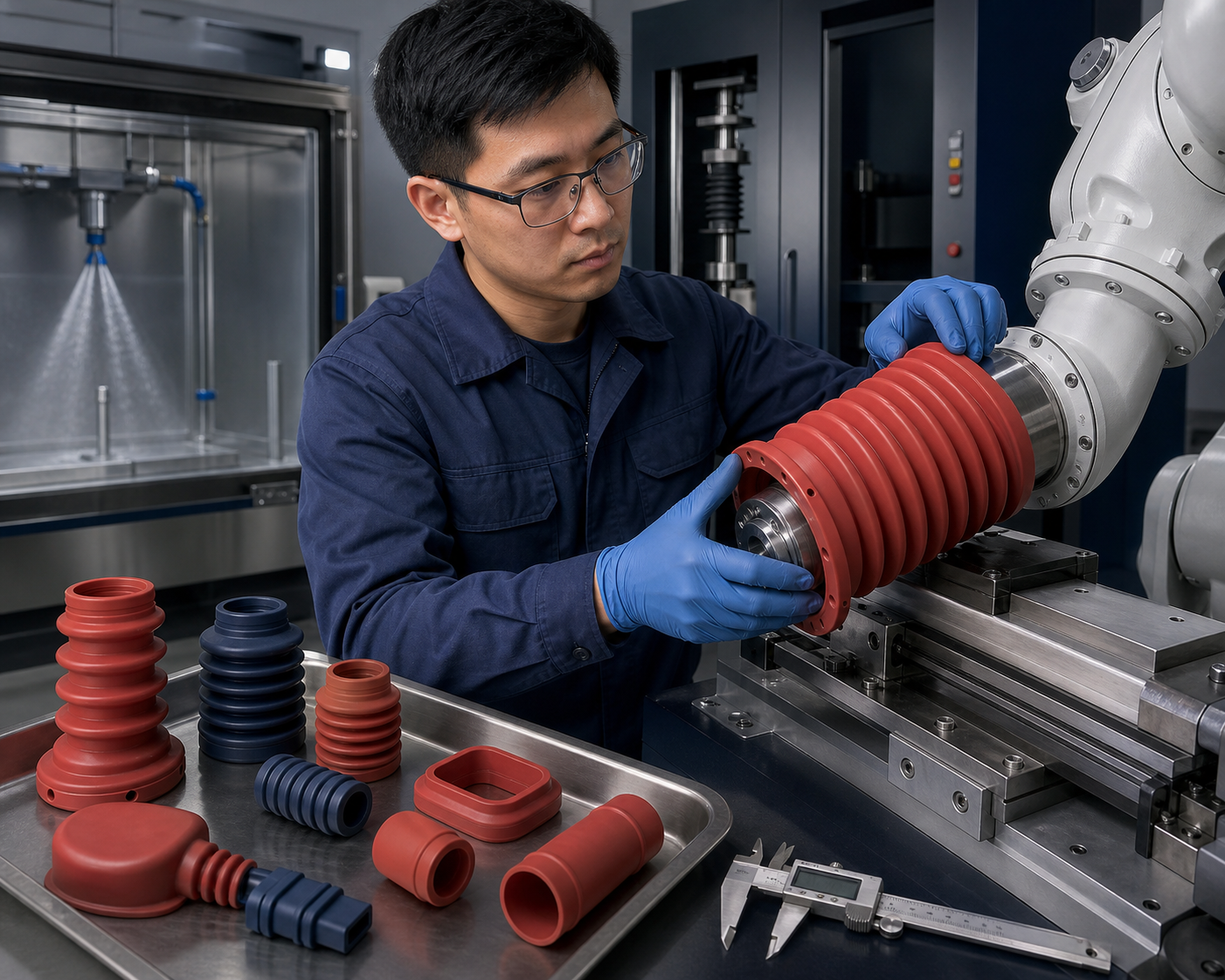
Protect moving interfaces without restricting the motion they require
Final material, geometry, tolerances and documentation must be confirmed against the drawing and operating conditions.
A silicone bellow or boot must balance flexibility, recovery, sealing and fatigue resistance. The convolution geometry, wall thickness, attachment features and working stroke all influence stress during compression, extension, bending or angular movement.
LSAN develops molded bellows, expansion boots, cable boots, dust covers, connector sleeves and custom equipment covers around the actual movement envelope. Housing geometry and installation method are reviewed together with environmental exposure.
These parts are common in robotics, aerospace assemblies, medical devices, industrial machinery and defense equipment where a rigid guard cannot follow repeated movement.
Protection formats for moving assemblies
The design should protect the interface while avoiding buckling, excessive force or local strain during motion.
Expansion Bellows
Convoluted flexible components that compress and extend along a defined axis.
Dust & Shaft Boots
Protective boots for rods, shafts, joints and actuators exposed to contamination.
Cable & Connector Boots
Strain-relief and environmental protection at cable, tube and connector transitions.
Flexible Equipment Covers
Custom covers that shield sensitive surfaces, openings or mechanisms.
Connector Sleeves
Flexible sleeves used to bridge, seal or isolate adjoining components.
Robotic Joint Covers
Repeated-motion protection for grippers, joints, actuators and automation modules.
Define the part before tooling
| Motion envelope | Compressed, neutral and extended length plus bending or angular movement. |
|---|---|
| Convolution geometry | Number, pitch, depth and transition radii selected around stroke and force. |
| Attachment | Clamp grooves, flanges, lips, beads, holes or bonded interfaces. |
| Environment | Dust, splash, washdown, ozone, UV, temperature, chemicals and pressure differential. |
| Wall thickness | Balanced for flexibility, vacuum stability, handling and cycle durability. |
| Validation | Fit, actuation force, collapse, leakage and cycle criteria defined by project. |
Values and options above are design starting points, not a universal product specification. Final capability depends on compound, geometry, size, tooling and inspection method.
Motion must be defined in every direction
- Provide the complete compressed and extended positions, not only the neutral shape.
- Use smooth radii at convolution roots and attachment transitions to reduce fatigue concentration.
- Check whether trapped air needs a vent or whether the bellow must hold pressure or vacuum.
- Ensure neighboring components do not rub, pinch or over-compress the flexible wall.
- Design clamp grooves and mounting lips around the actual retention method and service access.
- Validate actuation force and fold behavior in the real assembly across the operating temperature range.
Choose the compound around exposure and function
General HCR Silicone
A practical choice for many industrial bellows, dust boots and flexible covers.
Liquid Silicone Rubber
Considered for detailed thin-wall geometry and repeatable higher-volume molding.
High-Temperature Silicone
Used where the boot or cover is close to heaters, engines or thermal processing equipment.
Flame-Retardant Silicone
Reviewed for electrical enclosures and equipment requiring stated flammability performance.
Conductive Silicone
Available for projects requiring electrical continuity, static control or EMI-related functionality.
Fluorosilicone
Considered where oil, fuel or aggressive media exposure limits standard silicone.
From requirement review to repeat production
A staged process makes approval criteria visible early and reduces avoidable sampling loops.
Movement & Environment Review
Confirm stroke, bending, attachment, pressure, contamination and temperature conditions.
Geometry & Material Design
Define convolution layout, wall, hardness and mounting features.
Tooling & Prototype
Produce molded samples for fit, motion and surface evaluation.
Assembly & Cycle Test
Verify force, fold pattern, leakage and fatigue behavior in the equipment.
Production & Inspection
Control attachment features, wall condition, dimensions and appearance after approval.
Where these parts are used
Flexible boots and bellows extend equipment life by separating sensitive moving interfaces from the surrounding environment.
Robotics
Joint covers, gripper boots, actuator bellows and cable protection.
Aerospace
Lightweight environmental covers for moving and connected assemblies.
Medical Equipment
Flexible protective components around adjustable or moving device interfaces.
Industrial Machinery
Shaft, rod, switch and connector protection in dusty or washdown environments.
Quality points for bellows, boots and covers
- Compressed and extended dimensions verified against the defined motion envelope.
- Wall and convolution surfaces inspected for thin spots, tears, short fill and damaging flash.
- Mounting lips, grooves and holes checked for fit and retention.
- Leak or pressure test included when environmental isolation is a functional requirement.
- Cycle or motion testing performed to the agreed sampling plan when fatigue performance is critical.
Documentation is material- and project-specific
Food-contact, medical, flame-retardant, electrical or chemical requirements should be stated at RFQ stage. LSAN will review the requested standard and available material documentation before quotation. A material option should not be treated as certified for every application unless the corresponding documentation is supplied and accepted.
STEP/STP, IGES, PDF drawing, material or regulatory requirement, annual quantity, target hardness, color and intended operating environment.
Manufacturing context behind the guidance
5,000 m²Production facility
Nanjing Lsan Co., Ltd. develops and manufactures silicone rubber products in Nanjing, China. Technical content on this page reflects our manufacturing workflow and is intended to help engineers and buyers prepare a more complete RFQ. Final recommendations are made only after application and drawing review. Page updated August 2026.
Questions buyers ask before requesting a quote
What information is needed to design a bellow?
Provide neutral, compressed and extended lengths, diameters, movement direction, mounting method, environment, pressure or vacuum and target cycles.
Can a silicone bellow hold vacuum?
It may, but thin convolutions can collapse. Vacuum level, unsupported diameter and geometry must be reviewed and validated.
How do you prevent fatigue cracks?
Use smooth transitions, balanced wall thickness, controlled stroke and a compound matched to the temperature and cycle conditions.
Can boots be molded over a connector or insert?
Potentially. Insert compatibility, retention, sealing and processing temperature must be reviewed as an overmolding project.
Can you make flame-retardant or conductive bellows?
Specialty compounds may be available, but the exact requirement and supporting documentation must be confirmed before quotation.
Continue your technical review
Compare adjacent manufacturing routes before fixing the material and tooling strategy.
Have a drawing, sample or application challenge?
Send the requirements and LSAN will help define the next practical manufacturing step.