Custom Molded Silicone Parts Made to Your Drawing
Compression-molded, transfer-molded and liquid silicone components developed around geometry, performance, assembly conditions and production volume.
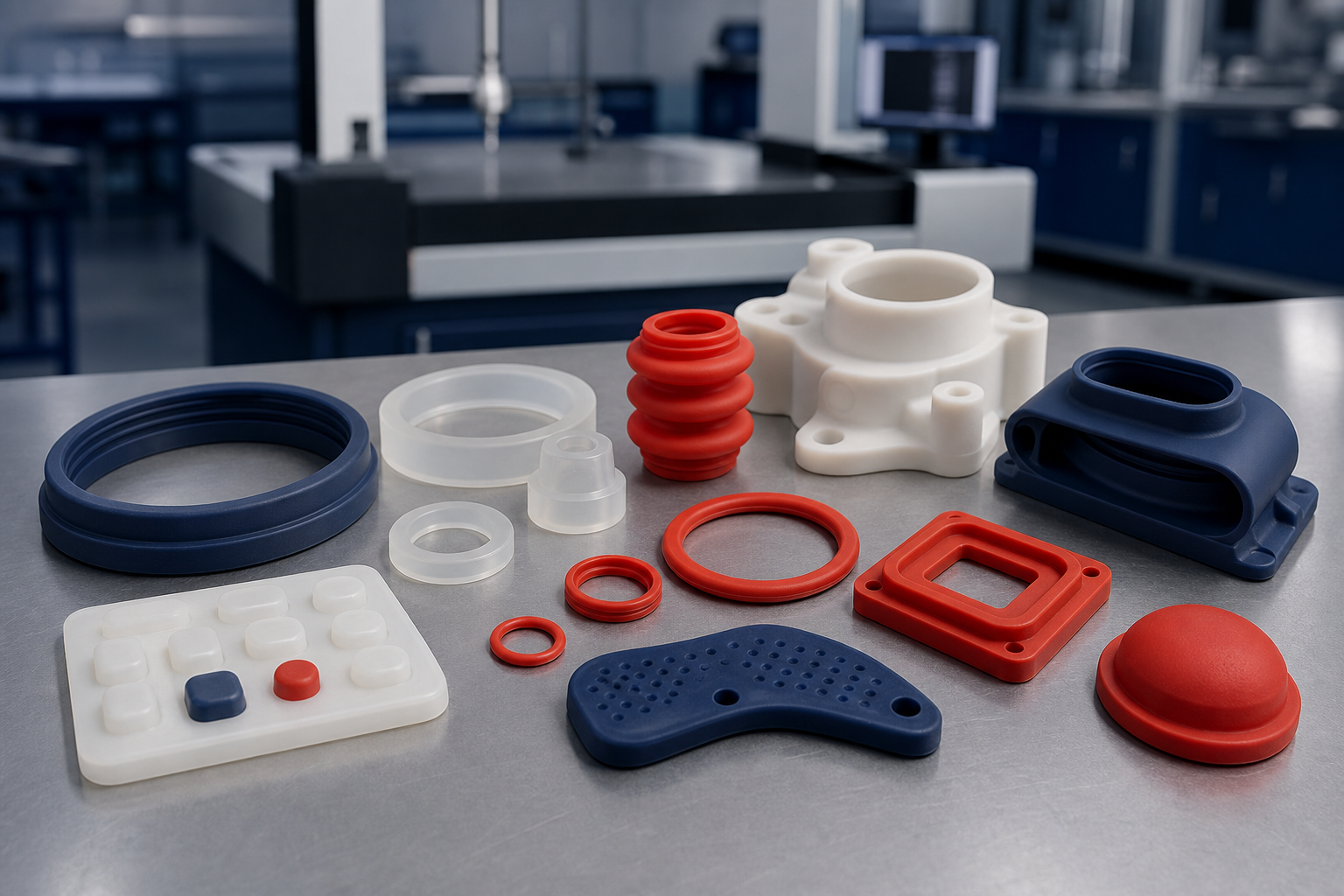
Complex geometry, controlled as a repeatable molded component
Final material, geometry, tolerances and documentation must be confirmed against the drawing and operating conditions.
Custom molded silicone parts are used when a component cannot be efficiently cut from sheet or produced as a continuous extrusion. Ribs, lips, curved surfaces, textured areas, sealing beads, internal features and molded-in inserts can be created within a dedicated tool.
LSAN reviews the part as a complete system: how it assembles, where it seals, what it contacts, how it moves and which dimensions drive function. This lets the team compare compression molding, transfer molding and LSR injection before tooling.
Typical projects include protective covers, vibration dampers, insulators, keypads, pads, suction cups, rollers and application-specific components for medical devices, aerospace assemblies, defense equipment and robotics.
Molded formats for functional assemblies
The final molding route depends on geometry, compound behavior, production volume and the level of automation required.
Complex-Shaped Components
Non-standard housings, covers, interfaces and functional parts with ribs, bosses, lips or contoured surfaces.
Vibration Dampers & Pads
Energy-absorbing components for equipment isolation, impact control, cushioning and noise reduction.
Buttons, Keypads & Grips
Tactile interfaces and soft-touch components with legends, textures, conductive pills or assembly features when specified.
Suction Cups & Flexible Interfaces
Parts that rely on controlled flexibility, lip geometry and surface contact to create grip or vacuum response.
Insulators & Protective Parts
Electrical and environmental protection components designed around heat, dielectric or enclosure requirements.
Insert-Molded Components
Silicone molded around metal or compatible inserts when mechanical retention and positional control are required.
Define the part before tooling
| Input files | 2D drawing, 3D STEP/STP/IGES file or representative physical sample. |
|---|---|
| Typical hardness discussion | Often reviewed within approximately 20–80 Shore A; final range depends on compound and geometry. |
| Color & appearance | Custom color, translucency, texture and surface requirements can be reviewed. |
| Molding routes | HCR compression molding, transfer molding or LSR injection molding according to the project. |
| Tolerance approach | Critical dimensions should be identified; achievable tolerance depends on size, compound, shrinkage and tool design. |
| Secondary operations | Trimming, post-curing, printing, bonding, inspection or assembly when required. |
Values and options above are design starting points, not a universal product specification. Final capability depends on compound, geometry, size, tooling and inspection method.
Geometry decisions that influence molding success
- Use consistent wall sections where possible to support filling, curing and stable shrinkage.
- Identify sealing surfaces, datum features and assembly-critical dimensions on the drawing.
- Define acceptable parting-line, flash and gate locations before tool approval.
- Review deep undercuts, reverse features and trapped air early; they may require tool actions or design changes.
- For inserts, specify material, surface condition, retention features and position tolerance.
- State functional test conditions—not only dimensions—when compression, actuation or sealing drives acceptance.
Choose the compound around exposure and function
General-Purpose HCR
A practical option for many industrial molded components requiring durability and temperature resistance.
Liquid Silicone Rubber
Suitable for precise, repeatable molding of detailed parts and higher-volume applications when geometry supports automated processing.
Platinum-Cured Silicone
Considered for low-odor, cleanliness-sensitive or regulated projects when the required supporting documentation is available.
High-Temperature Silicone
Reviewed when the component is exposed to elevated continuous or intermittent temperatures.
Flame-Retardant Silicone
Available compounds may be reviewed for electrical or enclosure projects with a stated flammability requirement.
Conductive or Specialty Silicone
Electrical, thermal, low-temperature or media-resistance requirements are evaluated case by case.
From requirement review to repeat production
A staged process makes approval criteria visible early and reduces avoidable sampling loops.
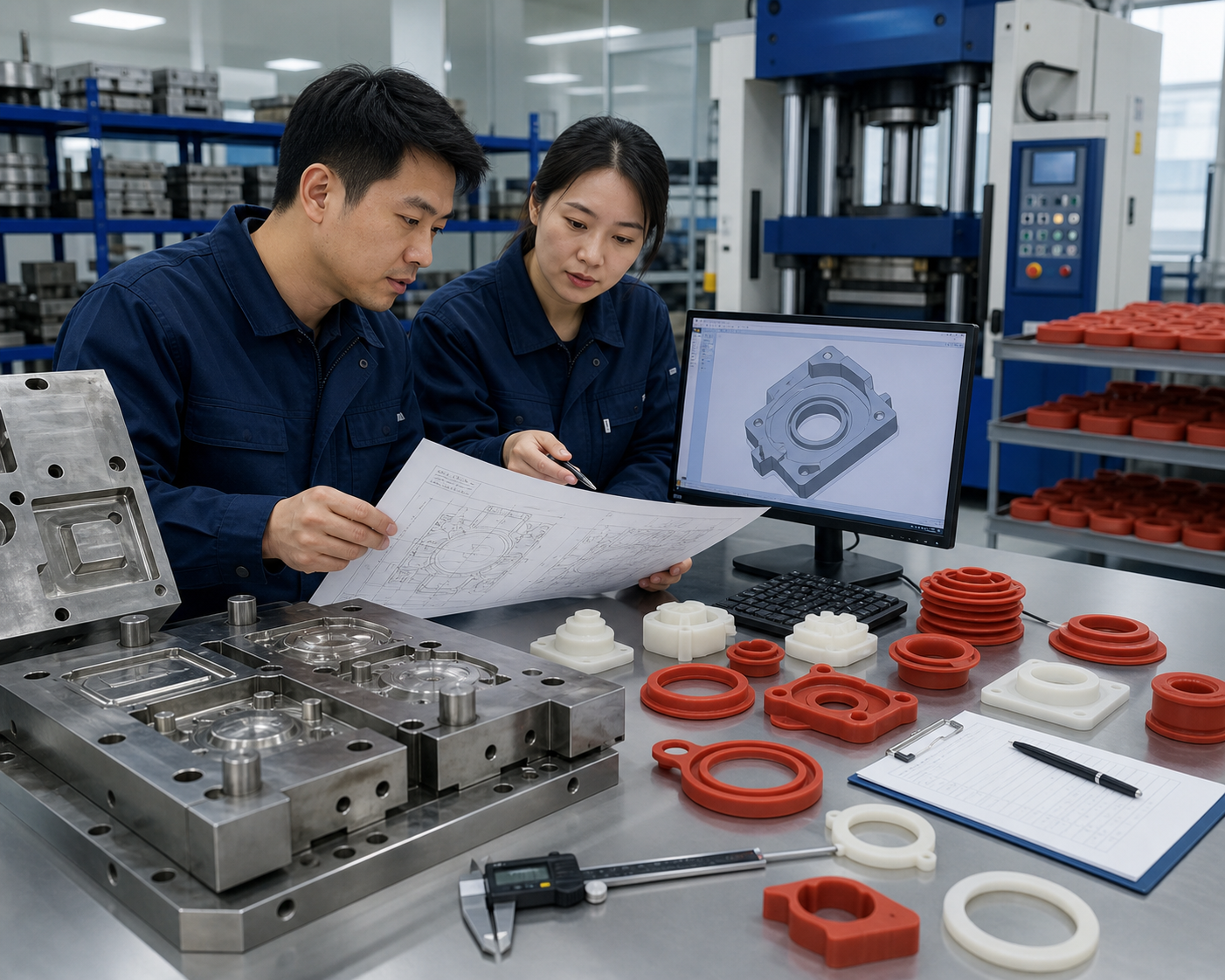
Drawing & Application Review
Confirm geometry, function, environment, material requirement, annual quantity and critical dimensions.
Process & Tooling Proposal
Select the molding route, parting strategy, cavity layout and expected secondary operations.
Tool Manufacture & Sampling
Produce tooling and initial samples for dimensional, appearance and assembly evaluation.
Customer Validation
Verify fit, function, hardness, color and agreed performance points in the final assembly.
Production & Repeat Control
Release batch production after approval and maintain the agreed drawing and inspection criteria.
Where these parts are used
Molded silicone is useful where flexible geometry, sealing, protection, comfort or vibration control must be integrated into one part.
Medical Devices
External interfaces, protective components, seals and soft-touch parts designed around device requirements.
Aerospace & Aviation
Environmental protection, vibration isolation and lightweight molded components for demanding assemblies.
Defense Systems
Rugged boots, pads, covers and seals produced to controlled project drawings.
Robotics & Automation
Gripper interfaces, damping parts, flexible covers and repeated-motion components.
Quality points for molded silicone parts
- Material batch and requested documentation checked against the approved project specification.
- Tooling sample compared with the drawing, assembly and identified critical-to-function features.
- Appearance review for contamination, unacceptable flash, short fill, tears, deformation or surface defects.
- Dimensional inspection method agreed for soft, flexible geometry where measurement technique affects results.
- Hardness, color, post-cure or functional tests included only where they are defined in the purchase specification.
Documentation is material- and project-specific
Food-contact, medical, flame-retardant, electrical or chemical requirements should be stated at RFQ stage. LSAN will review the requested standard and available material documentation before quotation. A material option should not be treated as certified for every application unless the corresponding documentation is supplied and accepted.
STEP/STP, IGES, PDF drawing, material or regulatory requirement, annual quantity, target hardness, color and intended operating environment.
Manufacturing context behind the guidance
5,000 m²Production facility
Nanjing Lsan Co., Ltd. develops and manufactures silicone rubber products in Nanjing, China. Technical content on this page reflects our manufacturing workflow and is intended to help engineers and buyers prepare a more complete RFQ. Final recommendations are made only after application and drawing review. Page updated August 2026.
Questions buyers ask before requesting a quote
Can you manufacture from a physical sample without a drawing?
Yes, a sample can support initial evaluation, but a controlled drawing or agreed dimensional record is recommended before production.
Which process is better: compression molding or LSR injection?
Compression molding is often practical for HCR, lower volumes and larger parts; LSR injection can support detailed geometry and automated higher-volume production. The part and quantity must be reviewed.
Can metal or plastic inserts be included?
Yes, subject to substrate compatibility, insert design, retention features, surface preparation and molding temperature.
What tolerance can you hold?
There is no single tolerance for all silicone parts. Size, hardness, compound shrinkage, parting line and measurement method must be considered together.
Can you provide samples before mass production?
Yes. Tooling samples are normally evaluated for dimensions, appearance, fit and function before the production release.
Continue your technical review
Compare adjacent manufacturing routes before fixing the material and tooling strategy.
Have a drawing, sample or application challenge?
Send the requirements and LSAN will help define the next practical manufacturing step.