Silicone Material Options for Custom Parts
Select silicone around temperature, media, mechanical function, sterilization, electrical behavior, color and required documentation—not from a grade name alone.
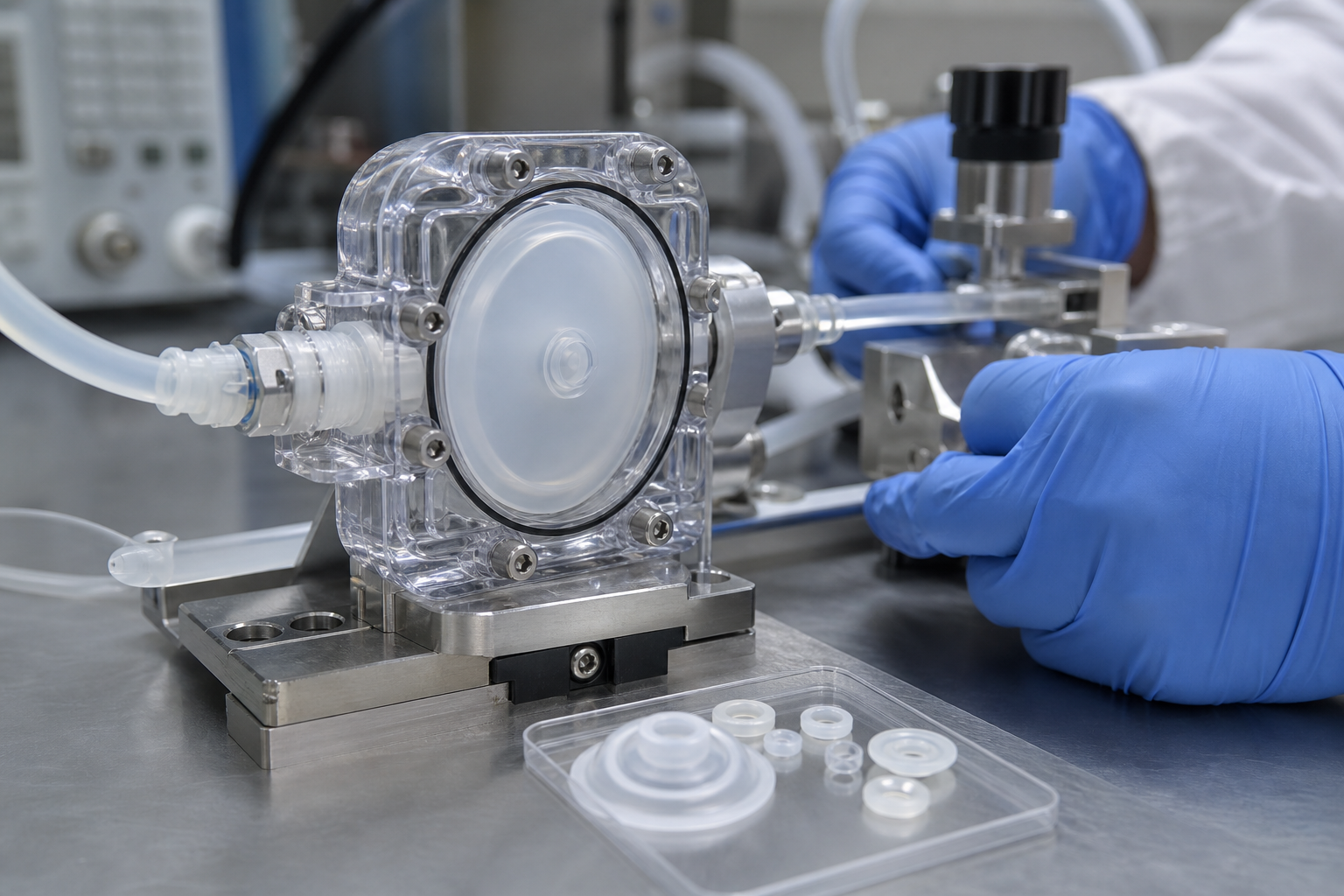
How do you choose silicone material?
Define the manufacturing process, temperature range, contact media, pressure or motion, target hardness, color, sterilization, electrical needs and required standards. Then compare available compounds and supporting documents against the final part—not only a generic material label.
“Medical grade,” “food grade” and “high temperature” are not complete part specifications. Different silicone families, cure systems, pigments and additives can affect processing, physical properties and available documentation. A compound suitable for one application is not automatically suitable for another.
LSAN begins with the function of the finished component. A dynamic diaphragm needs flex behavior; a gasket may depend on compression response; an aerospace part may introduce offgassing or fluid-compatibility requirements; an electrical enclosure may need a documented flammability classification for the exact material and thickness.
LSAN helps buyers turn application language into a material-selection checklist. Final compliance and device suitability remain project-specific and should be supported by the documents and validation required by the product owner.
Silicone families and specialty directions
These categories are starting points. Exact formulation, property values and documentation must be confirmed for the selected compound.
Solid Silicone / HCR
High-consistency rubber used in compression, transfer and selected extrusion processes for durable industrial components.
Explore HCR silicone →Liquid Silicone Rubber
Two-part liquid silicone suited to detailed injection molding and automated repeat production when geometry supports it.
Explore LSR →Medical-Grade Options
Materials reviewed against device contact, sterilization, formulation and requested biocompatibility documentation.
Medical material guidance →Food-Contact Options
Compounds considered with the specific food-contact regulation, extraction limits, process and intended conditions of use.
Food-contact guidance →High-Temperature Silicone
Compounds evaluated around continuous and intermittent exposure, load, media and expected service life.
High-temperature options →Fluorosilicone
A specialty direction for selected fuel, oil and chemical environments where standard silicone may be unsuitable.
Explore fluorosilicone →Flame-Retardant Silicone
Project-specific compounds reviewed against the required test method, rating, specimen thickness and supporting file.
Flammability guidance →Conductive Silicone
Electrically or thermally functional compounds for grounding, shielding or heat-transfer projects after property review.
Conductive options →Custom Color & Appearance
Color, translucency, surface texture and visual limits aligned with material behavior and approval samples.
Discuss your specification →Match the requirement to the material question
Use the matrix to prepare an RFQ; do not treat it as a universal material recommendation.
| Application requirement | Information to provide | Material direction to evaluate | Evidence to request |
|---|---|---|---|
| Medical-device contact | Contact type, duration, sterilization and final device configuration | Suitable medical-documentation silicone or LSR/HCR option | Compound-specific biocompatibility or supporting supplier documentation |
| Food contact | Food type, temperature, repeated use and cleaning conditions | Food-contact-compatible compound | Applicable regulation statement and test documentation |
| Elevated temperature | Continuous/intermittent temperature, load and surrounding media | High-temperature silicone formulation | Property data at relevant condition and validation plan |
| Fuel or oil exposure | Exact fluid, concentration, time, temperature and pressure | Fluorosilicone or validated specialty compound | Immersion or compatibility test method and acceptance criteria |
| Electrical application | Voltage, conductivity, shielding, thermal and flammability needs | Insulating, conductive or flame-retardant silicone | Material-specific electrical or flammability documentation |
| Repeated flexing or sealing | Deflection, cycle rate, compression, pressure and geometry | Compound and hardness selected with the part design | Functional test on representative final parts |
Questions that must be answered together
What does the part contact?
Name the exact fluid, tissue, food, cleaning agent, gas or mating material.
How long and how often?
Exposure duration and repeated cycles can change the relevant material risks.
What mechanical job does it do?
Sealing, damping, actuation, insulation and protection require different property priorities.
How is it processed?
HCR molding, LSR injection, extrusion and sheet conversion do not use identical formulations.
How will it be validated?
Agree specimen condition, test method, acceptance criteria and responsible party.
Which documents are mandatory?
Name the regulation, standard, customer specification and document revision at RFQ stage.
Material claims must be compound-specific
- Confirm the exact compound designation and supplier before relying on a data sheet.
- Separate raw-material evidence from finished-part or final-device validation.
- Check whether a rating applies at the specified thickness, color and processing condition.
- Record post-cure, cleaning or sterilization requirements that can affect the final part.
- Use agreed test methods for hardness, tensile, compression set, immersion or flammability.
- Avoid writing “FDA approved” when the actual requirement is compliance with a named food-contact regulation.
Useful sources for specification review
Confirm the current requirement for your market
- 21 CFR 177.2600 addresses rubber articles intended for repeated food-contact use in the United States.
- FDA biocompatibility basics emphasize evaluation of the final finished medical device and contact conditions.
- FDA guidance on ISO 10993-1 describes a risk-based approach for medical-device biological evaluation.
- UL Solutions’ UL 94 overview explains material flammability classifications and test orientations.
- ASTM D2240 covers durometer hardness, while other ASTM D11 methods address tensile, tear, compression and immersion behavior.
- NASA-STD-6001 demonstrates application-specific evaluation of flammability, offgassing and compatibility for relevant space programs.
Silicone material questions
Is all silicone suitable for medical devices?
No. Device contact, duration, formulation, processing, sterilization and the evidence required for the final device must be evaluated. A generic silicone label is not a biocompatibility conclusion.
Does “food grade” mean FDA approved?
Use precise language. In the United States, a supplier may provide evidence relevant to a named food-contact regulation such as 21 CFR 177.2600; FDA generally does not approve each custom rubber part.
How do I select Shore A hardness?
Hardness should be considered with wall thickness, geometry, compression, assembly force and functional testing. The same nominal hardness can behave differently in different part designs.
When should fluorosilicone be considered?
Fluorosilicone may be evaluated for selected fuel, oil or chemical environments. The exact media, temperature, exposure time and mechanical requirement must be defined.
Can a UL 94 rating be transferred to every finished part?
Not automatically. Confirm that the exact compound, thickness, color and test classification apply to the project, and review final product requirements separately.
Need help defining the silicone material?
Send the application environment, drawing, process direction and documentation requirements.