Custom Silicone Manufacturing Capabilities
Compare molding, extrusion, die cutting, overmolding and tooling support around your component geometry, compound, annual volume, validation plan and inspection requirements.
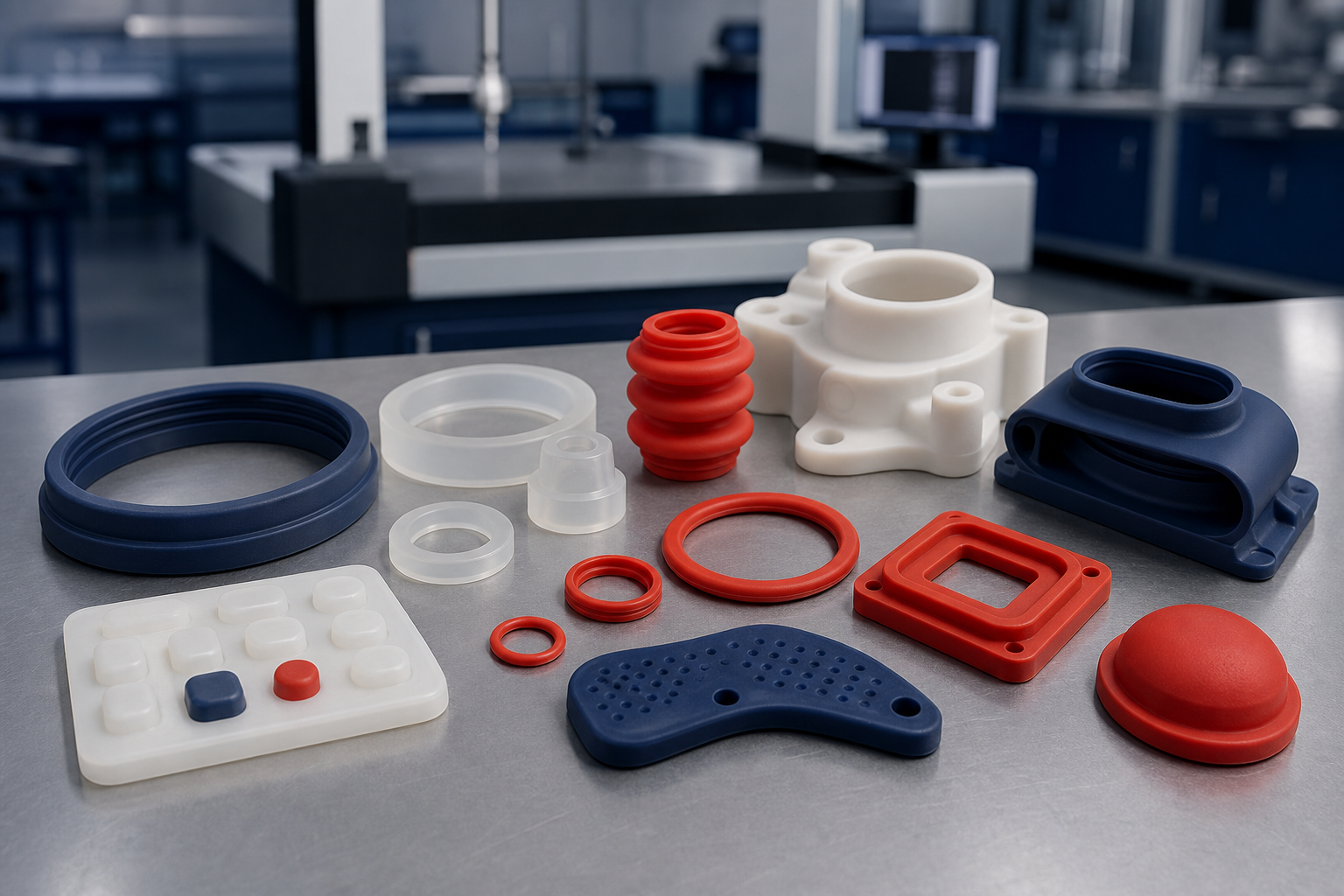
Which silicone manufacturing process should you use?
Compression molding suits many HCR components and lower-to-medium volumes; LSR injection supports detailed, repeatable higher-volume parts; extrusion creates continuous profiles; cutting produces flat gaskets; transfer molding and overmolding help integrate inserts or complex material flow.
Process selection starts with geometry, annual volume and functional risk. A flat gasket should not automatically become a molded part, and a detailed three-dimensional seal may be unsuitable for simple die cutting. Tool cost, cycle time, material behavior, secondary operations and inspection all need to be evaluated together.
LSAN reviews a project through its complete route: drawing intake, material direction, manufacturability, tool concept, sampling, customer validation and repeat production. This approach is especially important for medical devices, aerospace assemblies, defense equipment and robotics, where documentation and application conditions can be as important as part shape.
LSAN’s role is to make the process assumptions explicit before the customer commits to tooling. Final capability is confirmed only after the drawing, compound, quantity and acceptance criteria are reviewed.
Manufacturing routes for custom silicone parts
Each capability page explains the practical starting points, trade-offs and project inputs for that route.
Compression Molding
HCR silicone placed in a heated tool for custom seals, pads, covers and larger molded geometries.
View capability →LSR Injection Molding
Metered liquid silicone injection for detailed parts, automated processing and repeatable higher-volume production.
View capability →Transfer Molding
Controlled material transfer into the cavity for insert-related components and selected complex geometries.
View capability →Silicone Extrusion
Continuous tubing, cord and custom profiles with section control, cutting and optional joining operations.
View capability →Overmolding & Bonding
Silicone integrated with metal, plastic or other compatible substrates after retention and interface review.
View capability →Mold Design & Tooling
Parting strategy, cavity layout, gate, venting and maintainability planned around the production requirement.
View capability →Prototyping & Production
Sampling, engineering review, customer approval and controlled transition into repeat manufacturing.
View capability →Die Cutting & Conversion
Flat gaskets and pads converted from suitable silicone sheet when a dedicated molded geometry is unnecessary.
View product family →Secondary Operations
Trimming, post-curing, joining, bonding, printing, inspection and packaging defined by the project.
Discuss your requirements →Start with geometry and production intent
The table is a screening guide. Final selection depends on the actual drawing and compound.
| Manufacturing route | Typical part form | Useful when | Key review points |
|---|---|---|---|
| Compression molding | Three-dimensional HCR molded parts | Tooling simplicity, broad geometries and flexible production volumes matter | Charge placement, flash, parting line, cure and demolding |
| LSR injection molding | Detailed liquid-silicone components | Repeatability, automation and higher production volume justify the process | Gate, venting, cold-runner strategy, cavity balance and automation |
| Transfer molding | Insert parts and selected complex forms | Material must flow into a closed cavity around features or inserts | Transfer path, waste, insert stability and knit areas |
| Extrusion | Tubing, cord and continuous profiles | The cross-section remains constant along the length | Section tolerance, cure, cut length, joining and packaging |
| Die cutting | Flat gaskets, pads and insulation pieces | A two-dimensional shape can be converted from sheet | Sheet thickness, cutting tolerance, edge quality and adhesive |
| Overmolding | Silicone bonded to metal or plastic | Multiple materials must act as one functional assembly | Substrate compatibility, retention, surface preparation and test method |
Capability is more than forming the part
Manufacturability Review
Wall transitions, undercuts, draft, flash, gate and measurement risks are evaluated before tooling.
Material Traceability
Requested compound and supporting documents are confirmed against the approved project specification.
Tooling Approval
Tool concept, cavity count and sample assumptions are aligned before manufacture.
Sample Validation
Dimensions, appearance, fit and agreed functional tests are reviewed before production release.
Inspection Planning
Critical features require a practical method suited to flexible elastomeric parts.
Change Control
Drawing, material, tooling and process changes should be reviewed against the approved baseline.
Define acceptance before the first sample
- Identify critical-to-function dimensions and suitable measurement fixtures.
- State appearance limits for flash, gate vestige, contamination, deformation and surface finish.
- Define hardness, tensile, tear, compression-set or immersion testing only where function requires it.
- Agree which material certificates, declarations or test reports must accompany the order.
- Specify sample quantity, validation sequence and production-release authority.
- Keep application testing with the final assembly owner, especially for regulated products.
Standards that inform process discussions
Apply the standard named in the purchase specification
- ISO 3302-1 covers dimensional-tolerance classes for several solid-rubber product forms.
- ASTM D2240 addresses durometer hardness measurement.
- ASTM D11.10 lists methods for compression set, tensile, tear, dimensional measurement and other physical properties.
- FDA biocompatibility resources explain why a medical device must be evaluated in its final finished form.
- NASA-STD-6001 provides application-specific material evaluation requirements for relevant space programs.
Manufacturing capability questions
Can LSAN choose the process from my drawing?
LSAN can recommend a route after reviewing geometry, material, quantity, application and acceptance requirements. The recommendation becomes firm only when commercial and technical assumptions are confirmed.
Is LSR injection always better for precision parts?
No. LSR can support detailed automated molding, but compression or transfer molding may be more practical depending on size, compound, volume, tooling budget and part geometry.
Can you make prototypes before production tooling?
Prototype options depend on geometry and validation purpose. Some projects use soft tooling, machined samples, converted sheet or single-cavity tooling; these may not reproduce every production property.
Do you support inserts and multi-material parts?
Yes, subject to substrate compatibility, retention design, surface preparation, molding temperature and the agreed bond or pull-test method.
Which quality documents are available?
Document availability is material- and project-specific. State required certificates, declarations, inspection records or test reports during RFQ review.
Which process fits your silicone part?
Send the drawing, annual volume, material direction and operating conditions for review.