Material Testing Explained
Silicone Compression Set: How to Compare Test Results
Understand recovery measurements, compare complete test conditions and connect material evidence to a finished sealing joint.
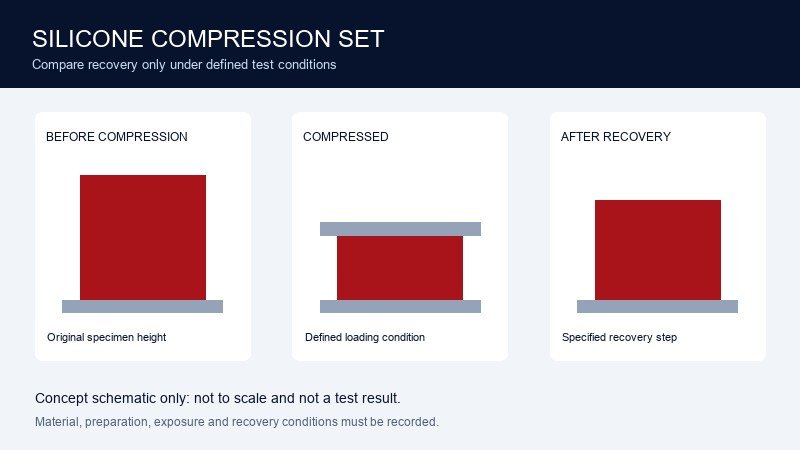
Silicone compression set describes the deformation remaining after a specimen has been compressed, released and allowed to recover under a defined procedure. It helps engineers compare recovery behavior, but the percentage on a material data sheet does not, by itself, tell a buyer whether a finished gasket will keep a particular enclosure sealed.
The useful question is therefore not simply which supplier reports the lowest number. It is whether the specimens, preparation, exposure and recovery conditions are comparable, and whether the chosen evidence addresses the joint's actual function.
For design engineers, quality teams and industrial purchasing staff, a complete comparison needs both the laboratory result and the application context. This article explains what to request, how to separate related properties and how to turn a promising material result into a reviewable sample-approval plan.
Silicone compression set is a recovery measurement under specified conditions. Compare values only after checking the method, specimen, material preparation, compression, exposure and recovery procedure; then validate the selected seal in its intended joint.
1. What does silicone compression set actually measure?
Think of the measurement as a controlled before-and-after comparison. The laboratory establishes the specimen's original dimension, applies the prescribed compressive condition, completes the exposure and measures the remaining deformation after the specified recovery step.
The reported percentage depends on how the method defines and calculates that deformation. Ask for the actual method and report rather than interpreting a bare percentage as a direct measurement of sealing force, leakage or remaining service life.
ASTM D395 describes methods for evaluating rubber under compressive stresses and identifies static stressing as the principal application of compression-set testing. That scope makes the test relevant to many sealing discussions without making it a complete simulation of every seal's duty cycle.
A permanently clamped cover, a regularly opened access door and a moving sealing lip can have different functional questions. A single recovery value may contribute to each discussion, but the supporting test program should reflect what the component actually does.
| Question | Evidence to request |
|---|---|
| Does the material recover after compression? | A compression-set result with complete conditions |
| Does the joint retain sufficient contact force? | Appropriate force-retention evidence and assembly validation |
| Can the cover be opened and resealed? | Recovery and repeated assembly checks in the actual joint |
| Will it meet a leakage requirement? | A defined functional test on the representative assembly |
Keep the product format visible in the comparison. A molded solid seal, a sheet-cut gasket and a cellular strip should not be treated as interchangeable specimens merely because all are called silicone.
The LSAN silicone product range separates these manufacturing formats. Start from the form your joint needs, then ask what material evidence applies to that form and its intended production process.
Read the condition before the percentage
An isolated value is an incomplete specification. Even when two documents use the same property name, different exposure temperatures, times, specimen preparation or recovery conditions may make the numbers unsuitable for direct ranking.
Treat missing conditions as an information gap. The appropriate next action is to obtain a comparable report or arrange a common test, rather than infer that the lower printed value must identify the better seal.
2. Make compression set testing comparable
Build a comparison sheet before discussing acceptance limits. Record the material identification, the test-method designation and version, specimen geometry, preparation history and all exposure and recovery conditions stated in the report.
The purpose is traceability: a reviewer should be able to identify what was tested and distinguish the laboratory sample from the production component. If the report omits a field, mark it as unknown and ask the supplier or laboratory to resolve it.
| Report field | Why it belongs in the comparison |
|---|---|
| Compound and batch identity | Connects the measurement to a particular material |
| Method and version | Identifies the procedure used to produce the result |
| Specimen type and dimensions | Distinguishes a test specimen from a finished seal |
| Cure and post-cure history | Records the material condition at testing |
| Applied compression or loading condition | Defines how the sample was constrained |
| Exposure temperature, duration and medium | Defines the aging environment |
| Release and recovery conditions | Identifies when and how recovery was assessed |
| Individual results and reported summary | Shows what the reported value represents |
ASTM D395 includes different loading approaches. A report that states only the standard number may therefore need more detail before it can be compared with another supplier's result.
Do not silently replace the specified method with a convenient laboratory practice. If a project needs a different condition to answer an application question, document it as an agreed test and keep that result distinguishable from the original standardized report.
Dow's silicone rubber selection guide is a useful reminder that compression-set data appear with material and test-condition information. Its grade-specific values are not a general rating for every silicone formulation, and they should not be presented as LSAN product data.
For a purchasing decision, request evidence for the proposed compound and production condition. A result for another grade may help with early discussion, but it should remain clearly labeled as reference information until equivalence is established.
Separate typical data from a purchase requirement
A typical data-sheet value describes the supplier's published characterization. An acceptance requirement is a limit agreed for your purchase, tied to a method, sampling plan and decision rule.
Ask whether the quoted property is guaranteed, tested per batch, checked periodically or supplied only as typical information. Those are different commercial and quality arrangements, even when the same number appears in the quotation.
3. Distinguish silicone gasket recovery from other properties
Compression set, hardness and force decay answer different questions. Keeping their meanings separate prevents a convenient measurement from becoming an unsupported substitute for a more relevant one.
ASTM D2240 describes durometer hardness as an indentation measurement and explains that it does not have a simple relationship to a fundamental material property. A hardness reading is therefore not a direct prediction of recovery, sealing force or lifetime.
Two candidates with the same nominal hardness still need their own evidence. Ask how each behaves under the intended compression and exposure rather than assuming the hardness label has already answered those questions.
| Property or test | Main question | What it does not establish alone |
|---|---|---|
| Durometer hardness | How does the material resist specified indentation? | Finished-joint force or long-term recovery |
| Compression set | What deformation remains after the prescribed recovery? | Leakage performance or retained force history |
| Compression force-deflection | What load accompanies a stated deformation? | Long-term retention under the full duty cycle |
| Compression stress relaxation | How does compressive force decay under the test conditions? | Complete service life of a particular assembly |
| Assembly leakage test | Does this assembly meet the stated leakage criterion? | Performance under untested future conditions |
ASTM D6147 specifically addresses force decay, or stress relaxation, in compression. That is a different measurement focus from dimensional recovery after release, so the two reports should be used for their respective purposes.
Silicone gasket recovery and compression stress relaxation are related design concerns but different measurements. A recovery result describes the condition after release; a force-decay test addresses force behavior during its defined compressed exposure. Neither removes the need to test the actual joint.
Avoid creating an informal conversion from one property to another. If a customer needs retained force, ask the test team to identify suitable force evidence rather than estimating it from a recovery percentage or hardness reading.
The same discipline applies when comparing solid and cellular materials. Confirm that the selected method and specimen are appropriate for the material form instead of transferring a requirement from a different construction without review.
4. Connect the data to the joint and operating environment
A seal works within an assembly. Its available space, contact surfaces, closure method and operating environment determine which material questions need to be answered before approval.
LSAN's custom silicone gaskets and seals page describes reviewing flange geometry, compression, temperature, media and environmental exposure together. This is a practical starting point for specifying the finished component rather than buying a recovery number in isolation.
LSAN supports drawing-based review of silicone sealing components and manufacturing formats. A useful enquiry includes the mating joint and service conditions so material, geometry, process and approval questions can be considered together; it should not presume that a generic data-sheet value approves the customer's assembly.
Record the conditions in concrete terms. Instead of writing only “high temperature,” describe the normal operation, excursions, dwell periods and whether the seal is compressed during heating, cooling, cleaning and storage.
- Identify the protected space and the required sealing function.
- Provide the mating geometry, tolerances and expected gap variation.
- Describe how the joint is closed and whether compression is limited mechanically.
- State whether the assembly stays closed or is reopened during service.
- List the relevant fluids, cleaners and exposure sequence.
- Define the functional acceptance check and the conditions under which it applies.
Thermal aging and liquid exposure deserve their own evidence when they are relevant. ASTM D573 provides an air-oven comparison framework, while ASTM D471 addresses effects of liquids on applicable rubber materials.
Both public scopes caution against assuming direct equivalence between laboratory exposure and actual service performance. Use these tests to inform the material assessment, then define the assembly-level evidence needed for the application.
Parker's O-Ring Handbook likewise places compression set within specified compression, time and temperature conditions. Its general explanation is useful background, but an O-ring discussion should not automatically become a design rule for every flat gasket, foam strip or custom molded seal.
Keep an application's individual uncertainties visible. A favorable laboratory comparison can justify advancing a candidate into a trial without implying that all environmental or mechanical questions are already closed.
5. Build an approval plan that answers the actual question
Start with the intended decision. A test designed to compare candidate materials can be useful without being a production acceptance test, and a production inspection may confirm conformity without establishing lifetime.
Label those purposes explicitly in the plan. This helps the engineering team, supplier and purchasing staff agree on what a successful result allows them to approve.
- Define the service question and the required assembly outcome before choosing a test.
- Identify candidate compounds and document the proposed production condition.
- Compare complete material reports and resolve missing or incompatible test conditions.
- Select representative samples and agree the exposure, assembly and measurement sequence.
- Evaluate both material observations and the finished-joint acceptance criteria.
- Record the approved combination, remaining limitations and conditions requiring review.
Keep baseline observations before exposure. Measurements, photographs and assembly notes can help separate a change produced during the trial from an issue that existed in the sample or fixture at the beginning.
Record deviations as they occur rather than explaining them from memory at the end. An altered fixture, changed cleaning step or interrupted exposure may affect what can reasonably be concluded from the result.
| Approval stage | Suggested record |
|---|---|
| Before trial | Drawing revision, sample identity and agreed acceptance criteria |
| During trial | Actual assembly and exposure conditions, including deviations |
| After trial | Recovery observations and defined functional results |
| Approval | Scope of acceptance, decision owner and unresolved questions |
| Repeat production | Agreed controls and change-notification requirements |
Do not select an acceptance limit solely because it appears achievable in an existing data sheet. First establish why that limit is meaningful for the project and what separate functional evidence is still required.
If the application needs a lifetime prediction, treat that as an additional engineering task. A short comparative exposure is not, by itself, a defensible conversion into years of operation, replacement intervals or a warranty period.
The plan should also state what happens when the material result and assembly result disagree. Investigate the compound, geometry, assembly and test setup instead of treating either result as permission to ignore the other.
6. Recognize comparison mistakes before they reach purchasing
The most common problem is incomplete equivalence: two numbers look directly comparable while the conditions behind them differ. A disciplined review makes those differences explicit before price or delivery becomes the deciding factor.
Another mistake is treating a failed assembly test as proof that compression set alone caused the failure. A sealing problem deserves an investigation of the whole joint, supported by observations rather than a single assumed mechanism.
| Tempting shortcut | More useful next step |
|---|---|
| Choose the lowest printed percentage | Compare full conditions and the proposed material identity |
| Use hardness as a recovery guarantee | Obtain the relevant recovery and force evidence |
| Copy another product's acceptance limit | Establish a requirement for the present joint |
| Convert a short test into years of service | Define a justified durability evaluation separately |
| Change the compound after approval without review | Assess the effect on the approved evidence |
The following situations are illustrative planning examples, not reported LSAN customer projects or performance results. They show how the same property discussion can lead to different validation priorities.
An enclosure engineer reviewing a permanently closed cover: the material comparison should support a trial of the representative joint under its defined exposure. The acceptance plan should say how sealing is checked after exposure and which assembly tolerances are represented.
A maintenance team reviewing a frequently opened panel: the project also needs to understand reopening, inspection and resealing. Specify the relevant handling sequence and replacement criteria instead of assuming a continuously compressed specimen answers every service question.
A purchasing engineer comparing alternate suppliers: request a common comparison basis and distinguish typical characterization from contractual acceptance. Keep the approved compound and production condition connected to the quotation so an attractive price does not conceal a material substitution.
These examples do not require invented savings or universal thresholds. Their practical outcome is a clearer decision record: what was compared, what remains uncertain and what evidence is needed before the next approval.
7. Put the evidence into a usable material requirement
A useful requirement connects the material, measurement and application. It gives the supplier enough information to identify gaps and propose a testable route without promising a result that has not been demonstrated.
State the drawing revision and the proposed material identity. Specify the applicable test method, required conditions, agreed limit and evidence format where these are already defined; otherwise flag them as items for engineering agreement.
- Separate mandatory requirements from preferences and reference data.
- Identify which measurements apply to standard specimens and which apply to finished parts.
- Ask how samples are linked to the production batch or material lot.
- State whether a laboratory report, certificate or periodic verification is required.
- Keep the acceptance decision and any concessions in the controlled project record.
- Require review of changes that affect the approved material, geometry or process.
Do not describe an untested condition as compliant merely because the material family is silicone. The proposed compound and finished component still need to be assessed against the actual requirement.
During sourcing, distinguish unresolved technical questions from commercial assumptions. A quotation can identify a proposed route while explicitly leaving a material limit or validation sequence open for agreement.
After sample approval, retain the underlying evidence rather than only a signed cover sheet. A future reviewer should be able to connect the accepted part to the test conditions, drawing and application represented by that approval.
8. Questions buyers ask about compression-set results
Does a lower value always mean a better silicone seal?
A lower result under genuinely comparable conditions can indicate better recovery in that test. It does not independently establish suitability for the joint, because material form, geometry, assembly and exposure still need evaluation.
Can two suppliers use the same method and still report incomparable data?
Yes. Check the specimen, preparation, loading, exposure and recovery details as well as the method designation. Missing information should be resolved before ranking the results or writing a purchase limit.
Is compression stress relaxation a replacement for compression set testing?
The measurements address different questions. Select the evidence according to whether the decision concerns recovery, retained force or finished-assembly function; more than one test may be appropriate.
Can a published result determine a replacement interval?
Not by itself. A replacement rule needs evidence tied to the component, operating conditions and acceptance criterion, including relevant maintenance or reopening conditions.
What should I send when I do not know the right limit?
Send the joint drawing, application, operating conditions and failure concern. Ask the supplier and test team to help define a comparison and validation plan, keeping unagreed limits visible until the responsible engineering review is complete.
9. Start with the joint, then agree the evidence
A useful silicone compression set requirement begins with a defined question and ends with traceable evidence. The material number becomes meaningful when its conditions are understood and its limitations are connected to a real assembly decision.
Bring the drawing, gap and closure information, operating exposures, material preferences and approval expectations together. If you have existing supplier reports, include their full conditions and identify the issue you are trying to resolve rather than sending only the lowest value from a comparison table.
Use the LSAN silicone drawing-review process to organize those inputs and discuss the next manufacturing and validation steps. A clear requirement helps the team assess what can be proposed, what should be tested and which assumptions still need agreement before production.