Request a Silicone Part Drawing Review
Send a drawing, 3D file or representative sample so LSAN can review geometry, material direction, manufacturing route, tooling assumptions and the information still needed for a responsible quotation.
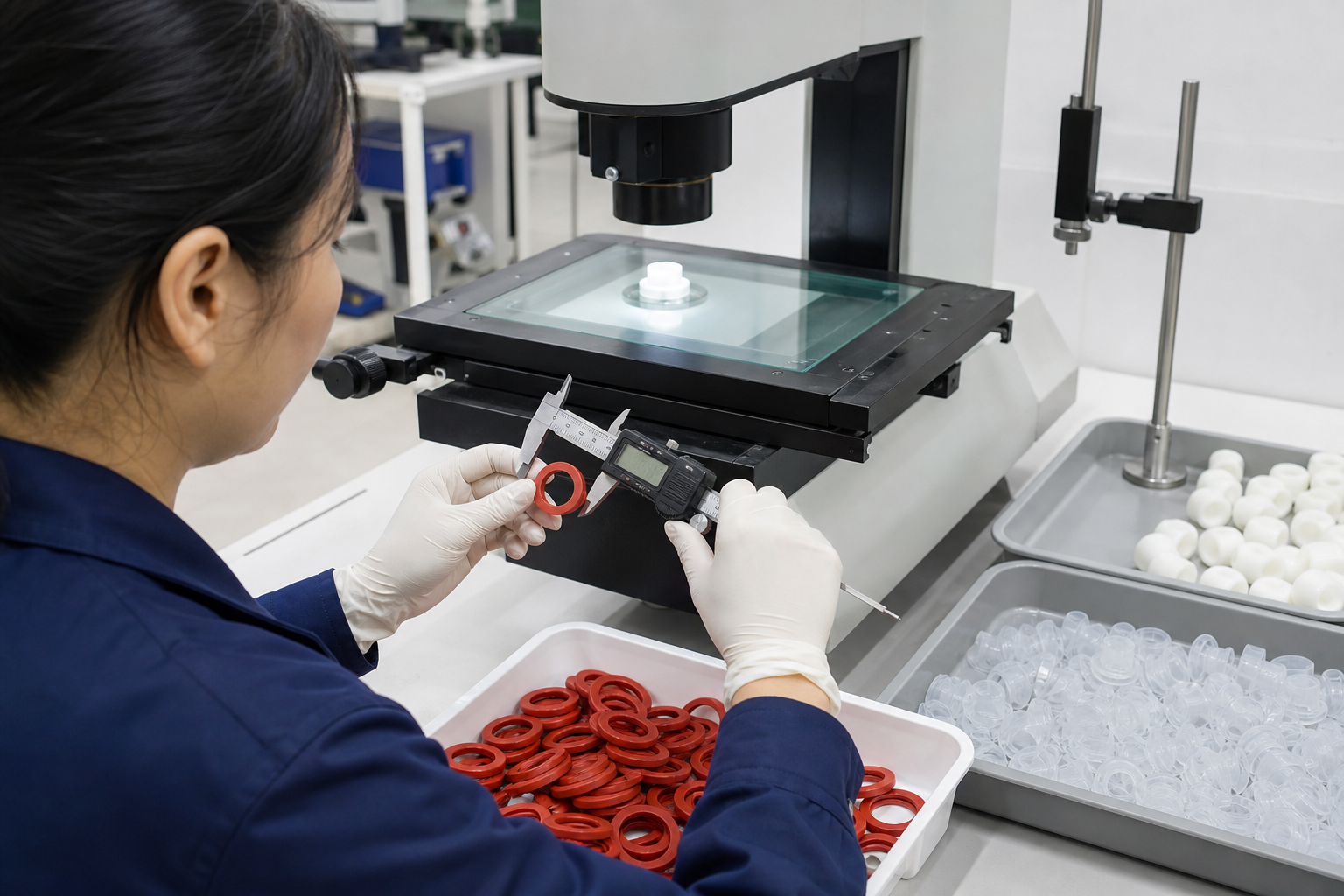
What does a silicone drawing review cover?
LSAN evaluates the part geometry, functional dimensions, material requirements, tooling approach, expected production volume and inspection needs. The output is a clearer RFQ scope—not an automatic guarantee that every stated tolerance or material claim is achievable.
A custom silicone component cannot be quoted responsibly from overall dimensions alone. Flexible materials deform during handling and measurement; molding shrinkage, parting lines, flash allowances, wall transitions and undercuts all influence the production route.
For medical, aerospace, defense or robotic applications, the review also needs the service environment. Tell us what the component contacts, how it moves, whether it seals, which surfaces are safety- or function-critical, and what supporting material documentation the project requires.
LSAN is most useful when the customer shares both the drawing and the reason behind the drawing. That context helps our team distinguish dimensions that control performance from dimensions that can be adjusted to improve tooling or repeatability.
What to send for an effective review
A complete package shortens clarification cycles and makes commercial assumptions visible before tooling begins.
Controlled Drawing
Provide a revision-controlled PDF showing dimensions, units, datums, tolerances, notes and the drawing owner.
3D Geometry
STEP, STP or IGES geometry helps the team evaluate undercuts, wall sections, parting strategy and insert positions.
Material Direction
State silicone type, hardness target, color, cure system and any regulatory or customer-specific requirement.
Operating Environment
Describe temperature range, chemicals, pressure, UV, ozone, sterilization, electrical exposure and contact duration.
Functional Priorities
Identify sealing lips, compression zones, moving features, cosmetic surfaces and assembly-critical dimensions.
Commercial Inputs
Include sample quantity, annual demand, target schedule, packaging needs and expected validation sequence.
From uploaded file to quotation assumptions
Each stage reduces ambiguity before the project moves into tooling and sampling.
Confirm the input package
Check revision, units, file completeness and whether a sample represents the intended production condition.
Identify the functional requirements
Separate critical sealing, assembly and motion requirements from general dimensions and appearance notes.
Compare manufacturing routes
Review compression molding, transfer molding, LSR injection, extrusion, die cutting or overmolding against the geometry and volume.
Review risk and test needs
Flag undercuts, difficult measurement conditions, material-documentation gaps and performance tests that require agreement.
Issue quotation assumptions
State the proposed route, tooling basis, sample plan, open questions and commercial conditions for customer confirmation.
Engineering questions behind the review
Can the part release from the tool?
Parting direction, undercuts, thin lips, insert retention and demolding stress are reviewed together.
Which dimensions control function?
Critical features need a realistic tolerance and an inspection method suited to flexible geometry.
Does the material match exposure?
Temperature alone is not enough; media, contact duration, sterilization and mechanical loading also matter.
How will the sample be approved?
Fit, function, hardness, color, appearance and documentation should be agreed before sampling.
What changes at production volume?
Cavity count, automation, secondary operations and inspection frequency depend on annual demand.
What remains customer-owned?
Final device validation, regulatory suitability and application acceptance remain with the product owner.
Information that often delays quotation
- A hardness is listed without the silicone family or cure system.
- A very tight tolerance is applied to every dimension without identifying critical features.
- The drawing omits parting-line, flash, gate or cosmetic-surface expectations.
- A compliance term is requested without naming the applicable regulation, test method or supporting document.
- Operating temperature is provided, but chemical contact, pressure, motion or sterilization is missing.
- Annual volume and sample quantity are not stated, making tooling strategy difficult to compare.
Standards used as review inputs
Reference points—not blanket certifications
- ISO 3302-1 defines dimensional-tolerance classes for molded, extruded and calendared solid rubber products.
- ASTM D2240 describes durometer hardness measurement for rubber and elastomeric materials.
- ASTM Committee D11.10 lists active rubber test methods including compression set, tensile and dimensional measurement.
- FDA biocompatibility guidance emphasizes evaluation of the final finished medical device and its contact conditions.
- NASA-STD-6001 illustrates why application-specific flammability, offgassing and compatibility requirements must be stated for space programs.
Drawing review questions
Can LSAN review a physical sample without a drawing?
Yes. A sample can support initial feasibility and reverse-engineering discussion, but a controlled drawing or agreed dimensional record is recommended before production release.
Do I need a 3D file?
A 3D file is strongly recommended for complex molded geometry. A clear 2D drawing may be sufficient for simple gaskets, profiles or parts with fully defined sections.
Will the review confirm exact tolerances?
The review identifies realistic starting points and critical questions. Final achievable tolerances depend on material, size, geometry, tooling, process and the agreed measurement method.
Can you recommend a silicone grade for a medical device?
LSAN can review material options against stated contact, sterilization and documentation needs. The device manufacturer remains responsible for final material selection, biocompatibility strategy and regulatory approval.
What happens after the review?
When inputs are sufficient, LSAN prepares quotation assumptions covering process, tooling, sampling and open items. Tooling starts only after commercial and technical confirmation.
Ready for an engineering review?
Send your drawing, material direction, annual volume and operating conditions through the inquiry form below.