Custom Silicone Diaphragms & Membranes for Repeated Flexing
Thin, reinforced, perforated and molded flexible components developed for pumps, valves, sensors, medical equipment and controlled fluid or air movement.
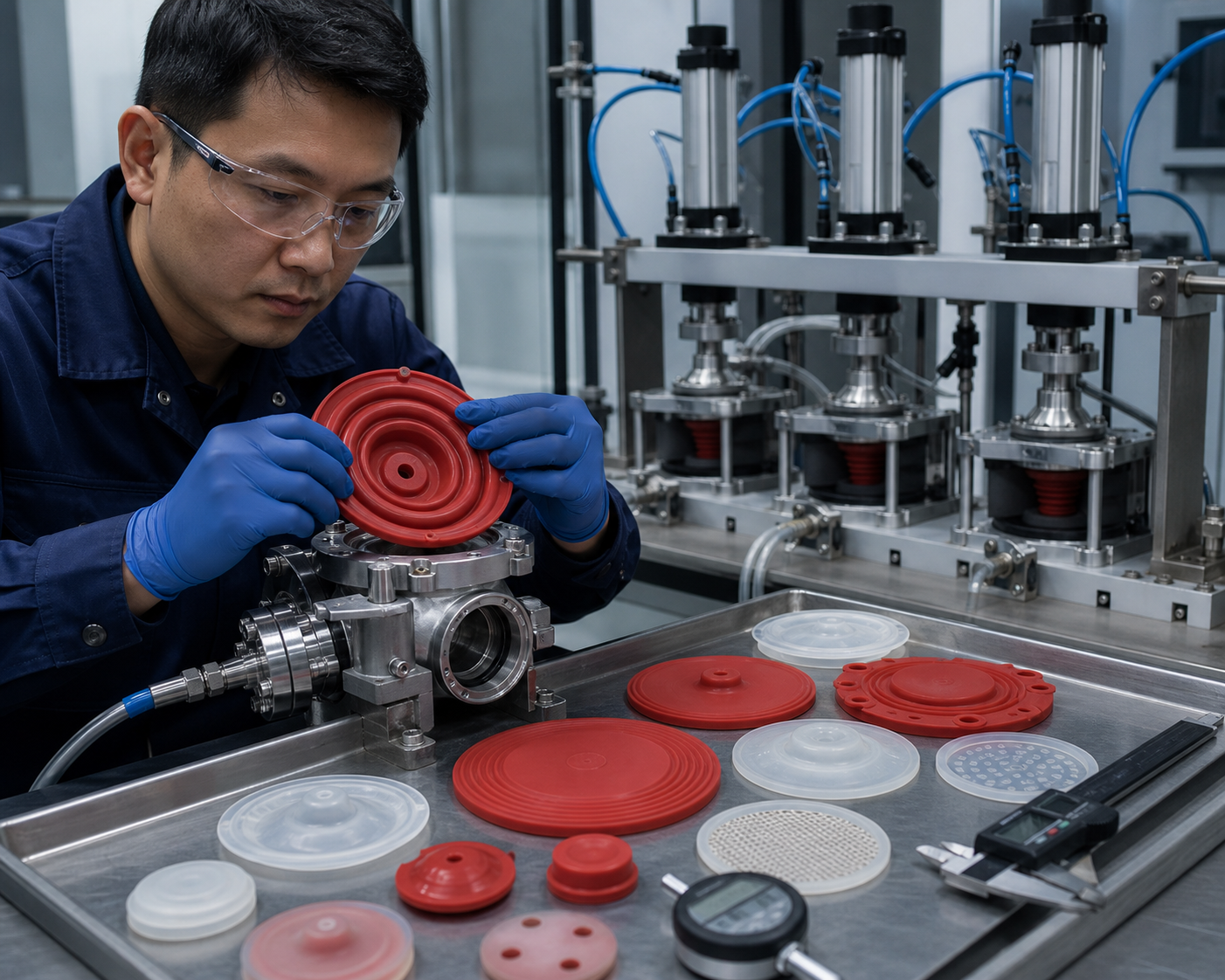
Control movement, pressure or separation with a designed flexible element
Final material, geometry, tolerances and documentation must be confirmed against the drawing and operating conditions.
Diaphragms and membranes are not simply thin pieces of silicone. Their behavior depends on thickness, active diameter, rolling or flexing geometry, pressure differential, stroke, frequency, media and how the edge is clamped.
LSAN supports flat membranes, molded diaphragms, pump and valve diaphragms, sensor membranes, perforated parts and fabric-reinforced constructions. The development process focuses on strain distribution, sealing at the perimeter and stable response over the expected cycle life.
Medical, fluid-control, aerospace and robotic projects often require closer discussion of cleanliness, documentation, thickness measurement and functional validation than ordinary molded parts.
Flexible formats for pressure and motion control
The active area and edge condition determine how stress moves through the part during every cycle.
Pump Diaphragms
Flexible elements that displace fluid or air through repeated pressure-driven movement.
Valve Diaphragms
Isolation and control components for opening, closing or regulating flow.
Thin Silicone Membranes
Uniform thin sections used for protection, sensing, separation or controlled flexibility.
Perforated Membranes
Parts with engineered holes or patterns for dispensing, venting, filtration support or flow control.
Sensor Membranes
Flexible interfaces that transmit pressure or displacement to a sensing element.
Reinforced Diaphragms
Silicone combined with fabric or another reinforcement to manage growth and repeated stress.
Define the part before tooling
| Functional inputs | Active diameter, clamp condition, stroke, pressure differential, cycle rate and required life. |
|---|---|
| Thickness | Set by response and strength requirements; very thin areas require dedicated tooling and measurement methods. |
| Hardness | Selected with thickness and geometry because all three affect force and response. |
| Reinforcement | Fabric type, orientation, exposed edge and bonding approach must be defined. |
| Media | Air, water, steam, chemicals, cleaners or biological-contact requirements must be stated. |
| Acceptance | Fit, leak rate, displacement, burst, cycle or other functional tests agreed by project. |
Values and options above are design starting points, not a universal product specification. Final capability depends on compound, geometry, size, tooling and inspection method.
Reduce stress before increasing material strength
- Use generous transition radii between the active area, convolution and clamped edge.
- Avoid abrupt thickness changes and sharp corners in repeatedly flexed zones.
- Define the neutral position, full stroke and pressure direction on the assembly drawing.
- Consider a rolling diaphragm geometry when long stroke and low friction are required.
- For perforations, define hole size, pattern, spacing and allowable flash or blockage.
- Validate the diaphragm in the real assembly because clamp load and housing geometry affect response.
Choose the compound around exposure and function
General HCR Silicone
Used for many molded pump, valve and industrial diaphragm applications.
Liquid Silicone Rubber
Suitable for detailed, thin and repeatable molded geometry when the tool and part design support LSR processing.
Platinum-Cured Silicone
Considered for cleanliness-sensitive medical or food projects with the required documentation.
Fabric-Reinforced Silicone
Combines flexible sealing with controlled dimensional growth for pressure or cyclic applications.
Fluorosilicone
Reviewed when fuel, oil or chemical exposure exceeds the resistance of standard silicone.
Specialty Low-Temperature Grades
Evaluated for aerospace or outdoor systems requiring flexibility in cold conditions.
From requirement review to repeat production
A staged process makes approval criteria visible early and reduces avoidable sampling loops.
Application & Motion Review
Define pressure, stroke, cycle, media, edge clamping and functional acceptance.
Geometry & Material Proposal
Select thickness, convolution, hardness, reinforcement and molding process.
Tooling & Sample Build
Produce samples and measure critical thin sections using an agreed method.
Assembly & Cycle Validation
Customer verifies response, leakage, pressure and repeated movement in the actual device.
Controlled Production
Release production with defined inspection and functional test sampling.
Where these parts are used
Diaphragms are used where flexible separation, pumping, sensing or pressure response must remain stable over repeated movement.
Medical Devices
Pump, valve, sensor and protective membranes with project-specific cleanliness and documentation needs.
Pumps & Fluid Control
Metering, dosing, pressure regulation and media-isolation diaphragms.
Aerospace & Defense
Flexible control and environmental components exposed to temperature and pressure changes.
Robotics & Automation
Pneumatic, vacuum, dispensing and sensor interfaces with repeated motion.
Quality points for diaphragms and membranes
- Thickness measured using a method that avoids compressing or distorting the flexible section.
- Active diameter, clamp features and convolution geometry inspected against the approved drawing.
- Surface checked for pinholes, tears, inclusions, blocked perforations or unacceptable flash.
- Reinforcement alignment, exposure and bond condition reviewed where fabric is used.
- Leak, pressure, displacement or cycle testing applied according to the agreed validation plan.
Documentation is material- and project-specific
Food-contact, medical, flame-retardant, electrical or chemical requirements should be stated at RFQ stage. LSAN will review the requested standard and available material documentation before quotation. A material option should not be treated as certified for every application unless the corresponding documentation is supplied and accepted.
STEP/STP, IGES, PDF drawing, material or regulatory requirement, annual quantity, target hardness, color and intended operating environment.
Manufacturing context behind the guidance
5,000 m²Production facility
Nanjing Lsan Co., Ltd. develops and manufactures silicone rubber products in Nanjing, China. Technical content on this page reflects our manufacturing workflow and is intended to help engineers and buyers prepare a more complete RFQ. Final recommendations are made only after application and drawing review. Page updated August 2026.
Questions buyers ask before requesting a quote
How thin can a silicone membrane be?
Minimum practical thickness depends on area, hardness, tooling, handling and the measurement method. A drawing and functional requirement are needed before quoting.
Can you make micro-perforations?
Perforated features can be reviewed, but feasible hole size and pattern depend on membrane thickness, tooling and acceptable blockage or flash criteria.
When is fabric reinforcement needed?
Reinforcement helps control expansion and stress in pressure or cyclic applications, but it changes flexibility and must be designed into the edge and convolution.
How do you specify diaphragm life?
Provide stroke, pressure, cycle rate, temperature, media and target cycles. Final life must be validated in the actual assembly or an agreed test fixture.
Can diaphragms be made from medical-grade silicone?
Material options with medical documentation may be available. The required standard and contact classification must be stated and verified for the project.
Continue your technical review
Compare adjacent manufacturing routes before fixing the material and tooling strategy.
Have a drawing, sample or application challenge?
Send the requirements and LSAN will help define the next practical manufacturing step.