Custom Silicone Gaskets & Seals for Reliable Compression
Die-cut, molded and extruded sealing components engineered around flange geometry, compression, temperature, media and environmental exposure.
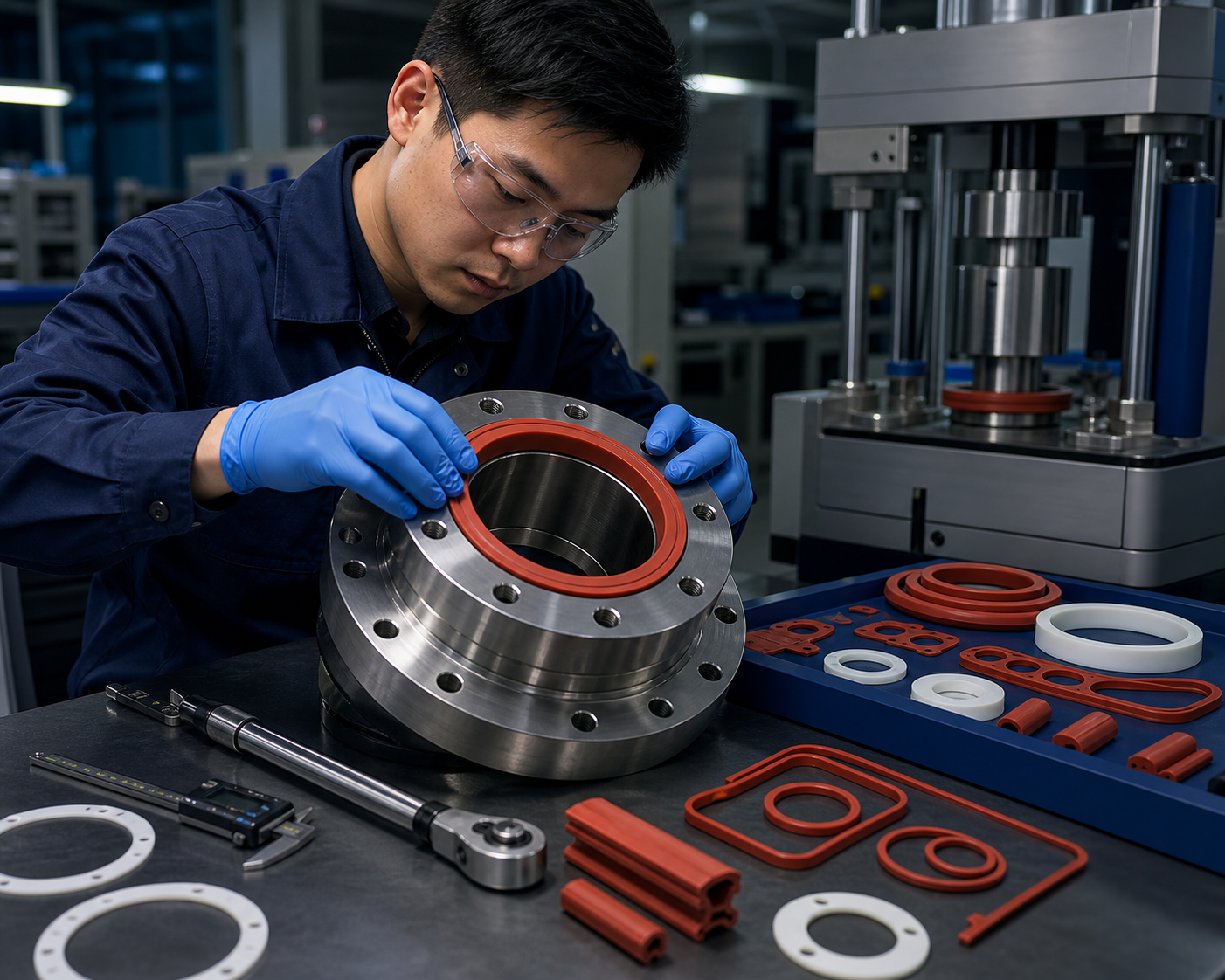
A seal must be designed as part of the joint—not selected in isolation
Final material, geometry, tolerances and documentation must be confirmed against the drawing and operating conditions.
A silicone gasket succeeds only when material, cross-section, compression and mating surfaces work together. LSAN reviews the enclosure or flange geometry, fastener pattern, pressure differential, temperature, media and maintenance cycle before recommending a manufacturing route.
Flat gaskets can be die-cut from solid, sponge or foam silicone sheet. Three-dimensional seals, beads and O-rings may be molded, while long profiles can be extruded and joined. Adhesive backing can assist assembly but should not be treated as the primary sealing mechanism unless specifically validated.
Projects range from electronics enclosures and medical equipment to food-processing machinery, aerospace assemblies and industrial access panels.
Sealing formats matched to the joint
Different geometries need different processes; the goal is stable contact pressure and repeatable assembly.
Flat & Frame Gaskets
Die-cut or waterjet-cut profiles for covers, panels, flanges and enclosure interfaces.
Molded Silicone Seals
Three-dimensional seals with integrated beads, lips, corners or attachment features.
O-Rings & Custom Rings
Circular or non-standard rings produced for static or dynamic sealing conditions.
Enclosure & Door Seals
Environmental seals for dust, moisture, washdown and repeated opening cycles.
Adhesive-Backed Gaskets
Assembly-aid constructions using selected pressure-sensitive adhesive systems.
Extruded & Joined Frames
Continuous profiles cut and joined into frames for larger doors, windows and equipment covers.
Define the part before tooling
| Joint information | Flange drawing, fastener locations, surface finish, gap variation and assembly load. |
|---|---|
| Material forms | Solid silicone, closed-cell sponge, silicone foam, molded HCR/LSR or extruded profiles. |
| Hardness / density | Selected according to compression load, joint stiffness and recovery requirement. |
| Media exposure | Air, water, steam, cleaning agents, oils, fuels or other fluids must be declared. |
| Compression target | Established from cross-section and material behavior; over-compression can shorten service life. |
| Documentation | Food-contact, medical, flame-retardant or chemical documentation reviewed by project. |
Values and options above are design starting points, not a universal product specification. Final capability depends on compound, geometry, size, tooling and inspection method.
Joint details that control sealing performance
- Provide the full flange or enclosure drawing, not only the gasket outline.
- Identify the intended compression range and the largest expected gap variation.
- Keep bolt spacing and flange stiffness consistent enough to avoid low-pressure leak paths.
- Use appropriate corner radii and avoid narrow bridges that can tear during handling.
- Specify whether the seal is static, frequently opened, sliding or exposed to pressure cycling.
- Validate adhesive selection against temperature, substrate, cleaning process and storage conditions.
Choose the compound around exposure and function
Solid Silicone
Used where dimensional stability, higher compression force and a dense sealing barrier are appropriate.
Closed-Cell Silicone Sponge
Reduces closure force and can accommodate larger gap variation in enclosure and door applications.
Silicone Foam
Useful for low-force cushioning and environmental sealing where very soft compression is required.
Food-Contact Silicone
Available options can be reviewed against the stated food-contact regulation and documentation requirement.
High-Temperature Silicone
Selected for ovens, thermal equipment and other hot environments after duty-cycle review.
Fluorosilicone / Specialty
Considered for fuel, oil or aggressive-media exposure where standard silicone may be unsuitable.
From requirement review to repeat production
A staged process makes approval criteria visible early and reduces avoidable sampling loops.
Joint Review
Evaluate flange, compression, media, temperature, cleaning and service requirements.
Material & Process Selection
Compare solid, sponge, foam, molded and extruded constructions.
Prototype / First Article
Cut or mold samples for fit, compression and assembly testing.
Functional Validation
Customer verifies leakage, closure force, environmental protection and service behavior.
Production Control
Inspect outline, critical dimensions, joint quality, material and packaging requirements.
Where these parts are used
Silicone sealing is widely used where temperature stability, weathering resistance and flexible recovery are important.
Medical Equipment
Device enclosures, access panels and fluid-interface seals with project-specific material requirements.
Aerospace Systems
Environmental seals and gaskets exposed to temperature cycling, vibration and controlled assembly loads.
Food Processing
Washdown, oven, hatch and equipment seals where documented food-contact materials may be required.
Electronics & Robotics
Dust, splash and enclosure seals for control systems, sensors, actuators and automation equipment.
Quality points for gaskets and seals
- Material type, thickness, hardness or density verified against the approved specification.
- Outline, holes, joints and critical cross-section dimensions inspected using an agreed method.
- Cut edges, molded flash, surface defects and adhesive condition reviewed before packing.
- Joined frames checked for joint location, alignment and integrity where applicable.
- Functional sealing or compression testing defined when drawing inspection alone cannot prove performance.
Documentation is material- and project-specific
Food-contact, medical, flame-retardant, electrical or chemical requirements should be stated at RFQ stage. LSAN will review the requested standard and available material documentation before quotation. A material option should not be treated as certified for every application unless the corresponding documentation is supplied and accepted.
STEP/STP, IGES, PDF drawing, material or regulatory requirement, annual quantity, target hardness, color and intended operating environment.
Manufacturing context behind the guidance
5,000 m²Production facility
Nanjing Lsan Co., Ltd. develops and manufactures silicone rubber products in Nanjing, China. Technical content on this page reflects our manufacturing workflow and is intended to help engineers and buyers prepare a more complete RFQ. Final recommendations are made only after application and drawing review. Page updated August 2026.
Questions buyers ask before requesting a quote
Should I use solid silicone or sponge silicone?
Solid silicone creates a denser barrier but requires more compression force. Closed-cell sponge can accommodate gap variation at a lower load. The joint stiffness and environment decide.
Can adhesive backing make the gasket seal better?
Adhesive mainly helps positioning during assembly. Long-term sealing should come from controlled compression unless a bonded construction is specifically engineered and tested.
Can you make one-piece molded frame gaskets?
Yes, geometry and size permitting. One-piece molding can avoid joined corners, while extruded-and-joined frames can be more practical for large sizes.
What information is needed for a sealing review?
Provide the gasket and flange drawings, media, temperature, pressure, gap, compression or closure load, service cycle and required documentation.
Can silicone seal oil or fuel?
Standard silicone is not ideal for every oil or fuel. Fluorosilicone or another elastomer may be more appropriate after chemical and temperature review.
Continue your technical review
Compare adjacent manufacturing routes before fixing the material and tooling strategy.
Have a drawing, sample or application challenge?
Send the requirements and LSAN will help define the next practical manufacturing step.